Survival Games
People Play
Discover the Invisible Forces That Shape Your Personality, Relationships, Decisions, and Destiny

About The Book
More importantly, it shows how awareness of these hidden forces can help you move beyond merely surviving—toward greater freedom, authentic relationships, and a deeper connection with your true Self.
What if the personality you call “yourself” is not your true identity at all, but a Survival Mechanism created long before you were aware of it?
Discover the Hidden Forces That Shape Your Life
What if your personality, emotions, relationships, and decisions are being guided by an invisible system you never knew existed?
Survival Games People Play introduces a groundbreaking framework that reveals how your Survival Mechanism begins forming before birth and continues to influence nearly every aspect of your life. Through powerful insights, real-life examples, and practical understanding, the book helps you uncover the unconscious patterns that drive conflict, self-sabotage, and repeated behaviors.
Did you choose to be born?
Did you choose your parents?
Did you choose your personality?
Did you choose the life you’ve been living?
Then perhaps the most important questions become…
What led to your birth?
Who has been playing the game?
What’s inside
The Hidden Survival Mechanism
Discover the invisible system formed before birth that quietly influences your thoughts, emotions, and behaviors throughout life.
Why We Become Different
Understand why people raised in similar environments often develop completely different personalities, relationships, and life paths.
The Three Survival Personalities
Learn the characteristics of the Wanted, Partly Wanted, and Unwanted Survival Mechanisms—and how each shapes human behavior.
The Birth of Self-Sabotage
Discover why intelligent, capable people unknowingly hold themselves back and repeat the same mistakes despite their best intentions.
The Invisible Games We Play
Recognize the unconscious psychological games that create repeated conflicts, emotional pain, and self-defeating patterns.
The Psychology Behind Relationships
See how unseen survival patterns influence attraction, conflict, marriage, parenting, friendships, and workplace interactions.
1. Survival Games
Did you choose to be born?
Did you choose your parents?
Did you choose your personality?
Did you choose the life you’ve been living?
Then perhaps the most important questions become…
What led to your birth?
Who has been playing the game?
Have you ever wondered why children born to the same parents and raised under the same roof often develop into remarkably different human beings? Within a single family, one child may grow up to be honest, loyal, responsible, and deeply committed, while another may exhibit manipulation, dishonesty, self-centeredness, or narcissistic tendencies. One child may be highly sensitive and empathetic, while another remains emotionally detached or indifferent. Such striking differences raise profound questions about human nature and human development.
Why do children born to the same parents think, feel, behave, and experience life so differently? How does one child develop a strong need for approval, another a deep desire for acceptance, and yet another an intense drive for survival, control, or achievement? What lies behind these similarities and differences? What shapes their unique personalities, beliefs, emotional patterns, and ways of interacting with the world?
It appears that certain patterns within human beings become so deeply ingrained that they function almost like hardwired systems. For example, some individuals who display narcissistic traits often struggle to function as honest, loyal, and committed individuals. They may repeatedly follow the same patterns of thinking and behaving, despite the consequences. But are people trained to become narcissistic? If so, who trains them, and how does this process occur? Or are these traits gradually and unconsciously revealed as individuals grow older? Are they merely expressions of a person’s survival strategy, or is there something far more profound taking place beneath the surface of human behavior?
Perhaps the question we need to ask is not merely why human beings are different, but whether each of us is unconsciously playing a different survival game—one that began long before we became self-aware.
Games
Games are a universal phenomenon involving all genders, races, and cultures, providing enjoyment, learning, and motivation through the desire to win. Losses promote strategizing and persistence, forming a cycle of challenge and reward. They originated from survival activities and social rituals, such as hunting and marriage contests, linked to honor and status. Ancient organized competitions shaped cultural identities. Today, sports like cricket in India and soccer in Brazil draw thousands of spectators. Beyond childhood, games build resilience and self-awareness, evoking emotional highs and lows whether playing or watching, making them deeply impactful.
Biological Software
Survival Games reveal the hidden design of survival that silently governs our lives. These games suck us in unconsciously, not because we choose them, but because the mechanisms are hardwired into our brains and operate on the ancient stimulus-response principle. At the heart of our existence lies a biological software — a system implanted in us through evolution — that manages both the input and output channels of our body.
The process is not random; it is structured upon foundational beliefs that shape behavior, emotional responses, and communication styles. These beliefs function as the fundamental rules of the system, determining reactions, emotional states, and how we connect with others.
Primary Purpose – Survival
Yet, despite its sophistication, we have little say in its design. We rarely pause to examine its workings, and most of the time, we remain unaware of how deeply it influences us. In fact, we identify with this system and say. “This is who I am.” Originally, this mechanism was crafted by nature with a singular purpose: SURVIVAL. It was meant to protect us from danger, to keep us alive in a world filled with threats.
A Protector and A Prison
This constant reactivity creates a cycle: an external stimulus triggers an internal response, which then shapes outward expression. Instead of consciously choosing how to act, we are carried along by the momentum of our survival programming. In this way, the survival system becomes both a protector and a prison —shielding us from imagined threats while simultaneously trapping us in patterns of emotional overreaction.
To recognize this design is the first step toward freedom. By becoming aware of the survival games we unconsciously play, we begin to see the difference between real danger and imagined threat. Awareness allows us to step outside the automatic loop, to reclaim choice, and to transform the very system that once controlled us into a tool for growth and conscious living.
Three Main Survival Mechanisms
This basic biological system varies among humans, similar to different computer platforms—iOS, Windows, Android. People rely on three main survival systems, each with distinct logic, all aimed at protecting the body. From birth, one of these programs is embedded in human biology, instinctively influencing perception, responses, and personality. Although all aim to protect, they follow different paths—fighting, fleeing, freezing, or fawning—shaping their reactions to challenges. These responses are the strategies of our biological software, explaining why people react differently in the same situation—some withdraw, others confront, or seek harmony. Each response reflects the hidden operating system guiding behavior, emotions, and choices.
The Emotional Highs
Our emotions signal highs and lows, like feeling ecstatic after winning a badminton match or feeling sad after a defeat. Games are emotional experiences that connect players, spectators, and communities with varying intensity. As we age, childhood games shift to serious “games of survival,” driven by adrenaline that activates the “fight-or-flight” response, sharpening senses and preparing us for challenges.
Survival Fate – Winning and Losing
Games involve winning and losing, reflecting polarities that shape existence. Life is based on binary opposites like day and night, and human society features polarities such as male and female, success and failure, wealth and poverty. Systems like banking and math mirror this duality. These opposites are not just contrasts but essential, complementary forces maintaining balance. Recognizing these as foundational helps explain how they define experiences and drive life’s evolution. Nature’s polarity creates internal balance, influencing thoughts, emotions, and behaviors, despite physical sameness.
Seeking Strokes for Survival
Structured settings from a young age teach us survival basics and prepare us for challenges. School is our first competition arena—academics, sports, or extracurriculars—where we build confidence through success. As adults, work demands continuous learning and validation, seeking recognition or ‘strokes’ for security. Each milestone grants a competitive edge, but the fear of losing relevance pushes us to impress others. Poor performance risks job loss, creating a paradox: striving for excellence aids survival, but constantly proving oneself causes anxiety. Humans instinctively seek financial security through savings and investments, using their talents to achieve stability.
Relationship is a Transaction
Survival encompasses more than just financial gain or career milestones; it also involves demonstrating competence in relationships. Driven by our instinct to secure resources, we often seek compatible partners, a process influenced by personal beliefs and societal expectations. Today, many rely on dating apps and marriage sites, where choices are made based on specific criteria—similar to selecting a product with desired features. This raises a profound question: Are we marrying a person or choosing a commodity?
Perhaps we do not merely seek relationships; perhaps we seek survival, security, validation, acceptance, and belonging through relationships.
Deep Inner Longing to Belong
Human belongingness is a core human need—a profound craving to be accepted, connected, and valued within families, communities, or groups. It is more than just casual social exchanges; it offers the reassurance that your presence is meaningful, that you are part of something bigger, and not isolated. Belonging gives us identity, stability, and emotional safety, tying individuals together through shared bonds and collective purpose.
Belonging fundamentally functions through two unconscious opposing forces: acceptance and rejection. Acceptance fosters confidence, happiness, and resilience, whereas rejection can lead to loneliness, self-doubt, and feelings of inadequacy. These opposing forces influence emotional well-being by affecting how individuals see themselves and interact with others. When recognized and included, we feel positive emotions that strengthen our sense of worth. In contrast, being ignored or excluded triggers negative feelings, highlighting the delicate nature of connection.
This constant push and pull mirrors the survival instinct embedded within us. We strive to thrive by seeking acceptance, adapting to rejection, and negotiating our place in the social game of life. Belonging, therefore, is not static—it is a dynamic process, a survival game that continues to unfold in every relationship, family, community, and society we inhabit.
The Unfinished Business
Acceptance and rejection trigger both positive and negative emotions. When these emotions become intense and control you—such as reacting strongly to a memory or situation—they signal active engagement in the survival game. These emotional charges often stem from events, past or present, that did not unfold as you expected or desired. Had they gone your way, they wouldn’t have left negative imprints. These unresolved experiences, known as “unfinished business,” linger in the unconscious and influence how you anticipate and respond to new challenges. This cycle of emotional reactions and projections keeps the survival game ongoing, shaping decisions, relationships, and behavior. Ultimately, survival extends beyond the physical realm; it is deeply emotional, integral to how we live and evolve.
The greatest illusion of human life is that we believe we are freely living, while much of our behavior is unconsciously devoted to survival. This book proposes that beneath our personalities lies a hidden Survival Mechanism, which eventually creates what we call the Self. To understand who we truly are, we must first understand the survival game we were born into.
Suppose such a mechanism exists:
- How does it function?
- How does a child absorb it?
- What determines which system a child will follow?
The deeper question is whether we are driven by forces we do not yet understand—and whether it is possible to uncover them.
Perhaps the differences we observe among siblings are not accidents of personality, chance, or upbringing alone. Perhaps they reflect different survival games operating beneath conscious awareness. The chapters that follow explore this possibility.
Chapters
Pages
An Invitation
This book does not ask you to accept its ideas simply because they are written here. Instead, it invites you to test them against the reality of your own life.
Observe your relationships. Notice your emotional reactions. Reflect on your decisions. Question the beliefs you inherited.
If these pages encourage you to become more aware of the invisible patterns shaping your life, then they have fulfilled their purpose.
True freedom does not come from changing the world around us. It begins by understanding the unseen forces within us.
About the author.

Lawrence V. Fernandes is a transformational therapist, author, and educator in Neuro-Linguistic Programming (NLP) and Clinical Hypnotherapy. For over two decades, he has helped individuals understand the unconscious patterns that shape their emotions, behaviors, relationships, and life choices.
Drawing on years of research, therapeutic practice, and personal insight, Lawrence developed the concept of the Survival Mechanism—a framework that explains why people think, feel, and behave differently despite similar life experiences. Through his books and teachings, he invites readers to question long-held assumptions, uncover the hidden forces influencing their lives, and move toward greater self-awareness, freedom, and authenticity.
Survival Games People Play is part of his continuing work to help people understand themselves more deeply and live beyond unconscious patterns.
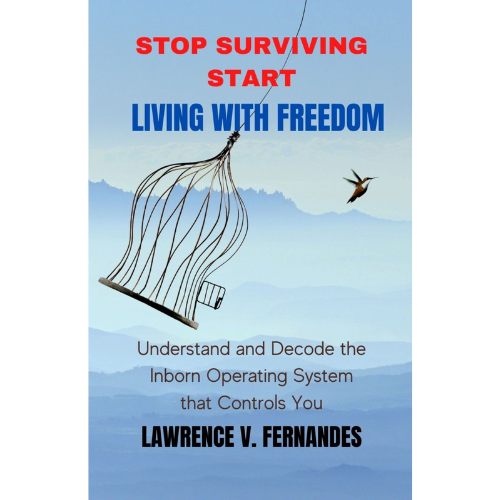
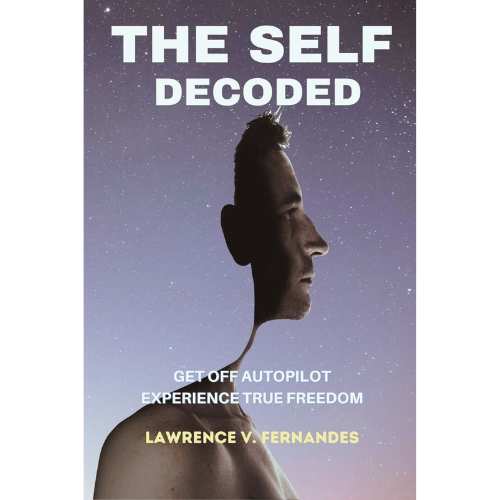
Lawrence is also the author of Stop Surviving, Start Living With Freedom, which introduces the concept of the three Survival Mechanisms, and The Self Decoded, which explores the nature and influence of the Self. Survival Games People Play builds upon these foundations, bringing them together into an integrated framework for understanding human behavior and conscious living.
Ways to connect with the author
Lawrence V Fernandes