
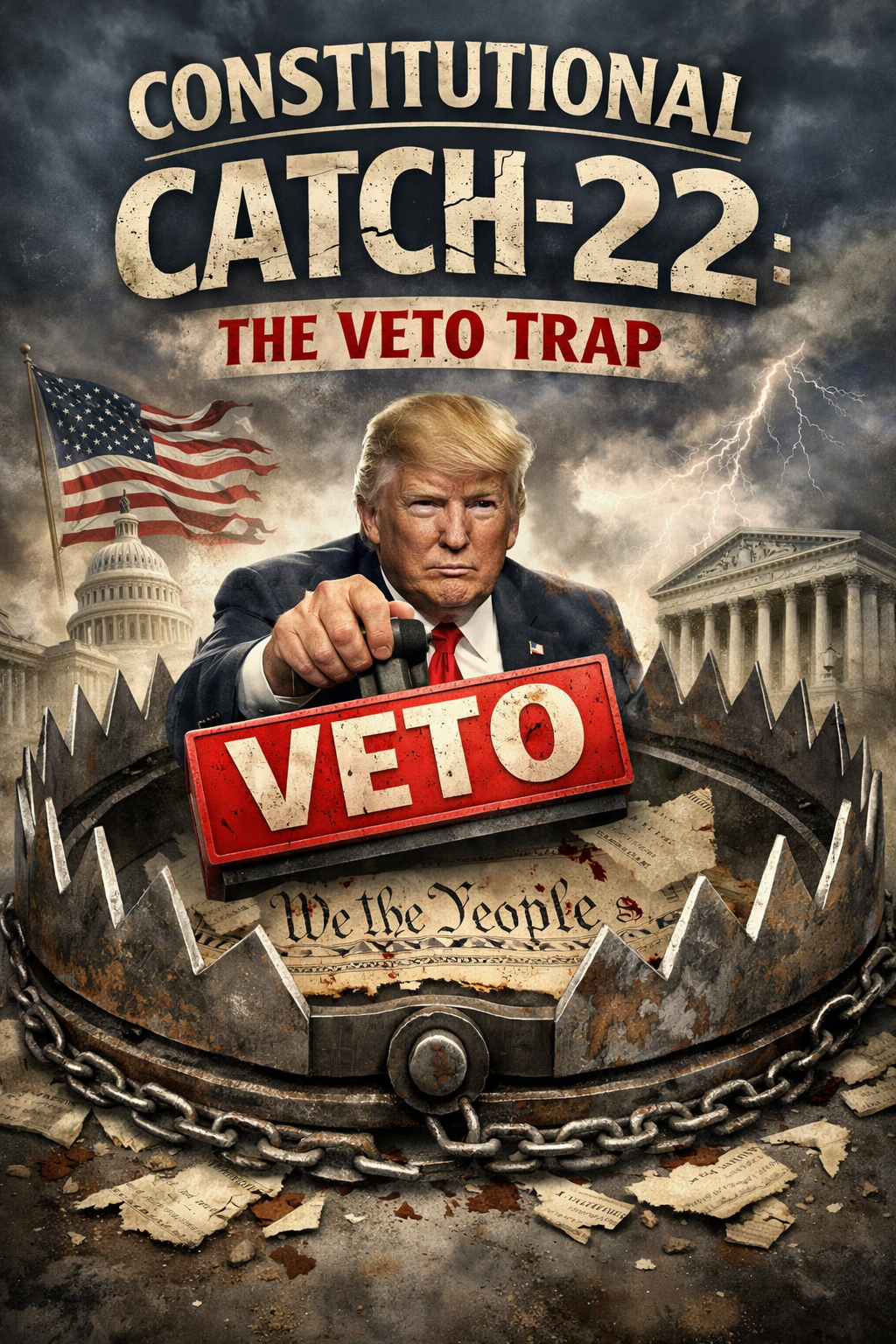
The U.S.–Iran conflict highlights not just the leaders’ power-driven mindsets but also the contradictions within the American system. President Trump’s survival instinct makes his decisions final, supported by Prime Minister Netanyahu’s similar drive for survival. They initiated a war that Congress never officially authorized, but still drains resources, reputation, and lives. This paradox—a war fought without approval—forms the core of the Constitutional Catch‑22.
The Veto Power Misused
The Constitution grants the president veto power and extensive authority over national security. These powers were intended to protect the nation from paralysis. However, in practice, they can be used by Trump to silence opposing voices and override dissent. Even when analysts warn of impending trouble, their warnings are often ignored by President Trump. The system meant to safeguard democracy can paradoxically become a tool for self-sabotage. It’s a paradox: the Constitution authorizes the leader to act in good faith, yet this very authority can lead to unintended harm.
The law is designed to safeguard the nation’s interests, but a leader’s character matters as well. President Trump seems more focused on defending his past wrongdoings and prioritizing his own interests. For more details, see the blog article, “USA – The Superpower’s Survival Trap.”
A War Without Approval
Congress has never officially declared war on Iran. Nevertheless, the conflict continues through executive language like “operations,” “security measures,” and “defensive actions.” This results in a de facto war that lacks formal legitimacy. The country faces a paradox: engaging in a war that isn’t recognized as legitimate, but is unable to withdraw without seeming weak. It’s a covert battle, where legality and reality diverge. The catch‑22 is clear: the U.S. cannot win a war it never officially launched, but it also cannot conclude it without admitting defeat.
The Survival Game
For Trump, this is not about legality or diplomacy. It is about survival. His trance demands dominance, even if it means bypassing institutions. “My way or the highway” becomes the guiding principle, and the nation and its citizens are dragged along. His team echoes his voice, allies mirror his rigidity, and dissent is vetoed. The survival game is personal, but the consequences are systemic. The leader’s instinct to survive overrides the nation’s well-being.
Reframes Retreat as Victimhood
As the war prolongs, its economic impact intensifies. Oil shortages push prices higher, fertilizer expenses increase, and inflation spreads globally. Countries relying on energy imports face hardship, and frustration grows. Allies start to distance themselves from the U.S., applying diplomatic and economic pressures to push for withdrawal. Meanwhile, Trump reinterprets retreat as a sign of victory, claiming, “I won the war, but had to withdraw because other countries were suffering.” This narrative conceals the reality: his own inflexibility triggered the crisis. The catch‑22 deepens—withdrawal is seen as victory, yet the war’s legitimacy is questionable from the start.
Veto Power Misused if the Smokescreen Fails
When the smokescreen fades and distractions clear, President Trump still confidently uses his constitutional veto as his ultimate safeguard. The veto isn’t just a legal tool but also a mental fortress that boosts his confidence and shields him from scrutiny. In this dance, the smokescreen gives him a bit of time by confusing critics and hiding accountability. But when contradictions come to light, and the illusions break down, the veto becomes his decisive weapon. It enables him to block opposition, silence dissent, and reaffirm his dominance, even when the truth is hard to ignore.
This mechanism turns vulnerability into a form of resilience. The veto effectively says, “Even if you see me, you can’t touch me.” This message helps restore a sense of invincibility and keeps humiliation at bay. The survival strategy here works in two steps: first, there’s the confusion caused by misdirection, and then the protective shield of veto power. Together, they make sure that being exposed doesn’t mean defeat, but rather an opportunity to reaffirm control. Psychologically, the veto acts like an ego’s insurance policy — a way to keep up the illusion of authority even when the façade starts to crack. So, even if the smoke screen disintegrates, the veto continues to reinforce the illusion of power, helping the survival game go on.
The Constitutional Catch-22 Loop
This captures the core of the Constitutional Catch‑22: a system that allows leaders to silence opposition, conduct unauthorized wars, and keep a nation in a cycle of self-destruction. Trump’s fight for survival turns into a systemic trap for the country. Whether it leads to collapse, endless conflicts, or economic estrangement, the result appears as strength but is ultimately defeat. The very Constitution designed to protect democracy and the nation ends up acting as its own undoing and cause of its downfall.
The military in a Catch-22
The military is bound to follow orders without question, whether they are right or wrong, as they are trained to do. An individual or a small group can manipulate the system to advance their own hidden agendas, and the military is tasked with executing these orders. This creates a trap, placing the system in a catch-22 and effectively sabotaging it at the national level. As a result, the US military and its personnel have no choice but to support President Trump and his personal agendas.
Trapped in its Own Loop
Ultimately, the U.S.–Iran conflict isn’t just about military confrontation. It’s a complex paradox, where intellectuals are silenced, advisors echo each other’s voices, personal agendas overshadow national goals, and an inflated ego of invincibility neglects practical concerns. The nation faces a storm that was predicted but ignored, a war that was never approved but still fought, and a trap that only the replacement of leadership can break. This is the final irony of these survival struggles is that the drive to endure often leads to self-destruction.


0 Comments