
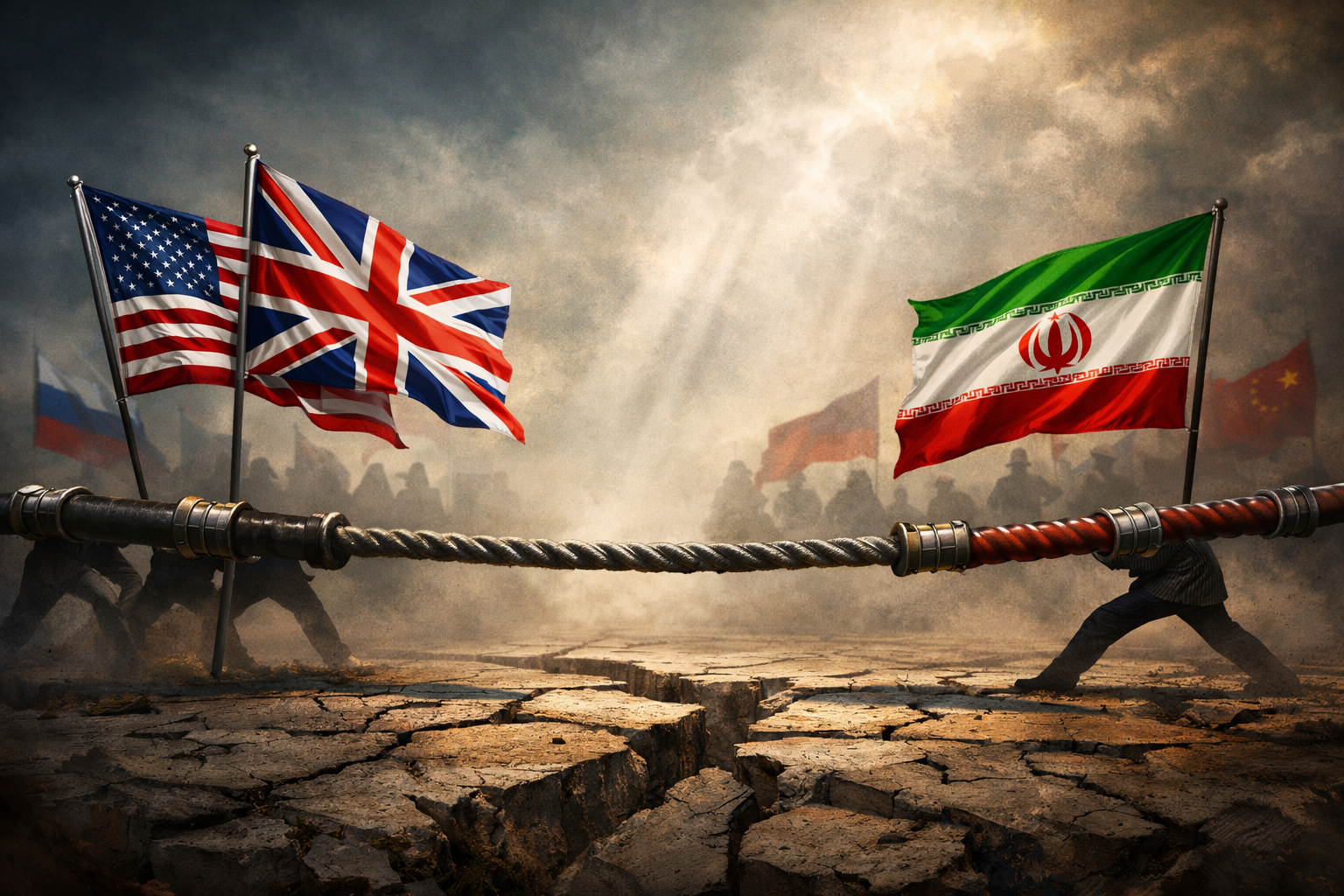
Survival Games Nations Play
Every game has a prize. Winning matters because the winner shapes the story and gets the reward. But what if the referee and the player are on the same team?
The contest is no longer fair. The rules change, decisions become biased, and the other side has almost no chance to win. The game shifts from skill to simply trying to survive in an unfair setting.
The Games Begin
Looking back at the US-Iran conflict, there was a time when Britain used Iran’s oil resources. Iran’s Prime Minister decided to nationalize the oil fields to benefit the country. For Britain, this meant losing valuable profits and control. For Iranians, it was a proud moment and a sign of independence.
Britain wanted Iranian oil but lost access when Iran nationalized its refineries. In response, Britain and the US planned the 1953 coup to remove Prime Minister Mohammad Mosaddegh and regain control over Iran’s resources. They installed the Shah of Iran as a ruler influenced by outside powers. Once again, Iran’s resources were exploited.
In 1979, a revolution overthrew the Shah. For the US and Britain, this was more than losing a leader—it hurt their pride. The new Iranian Islamic Republic took control of the country and its resources. After that, both countries lost access to Iran’s oil.
This sums up U.S.–Iran relations since 1953. The U.S. has been both a player, chasing its own interests, and a referee, setting the rules for finance, sanctions, and diplomacy. Iran, as the opponent, has to play in a game where the referee is not fair.
The Subtle Game of Arm-twisting Begins
Iran had $12 billion in US banks and paid $400 million for US military equipment. The US froze these assets for different reasons. At first, it looked like a simple legal move—just blocking funds until certain conditions were met.
The Vault That Became a Cage
Imagine trusting a bank with your savings. You deposit money, invest, and store valuables there, believing it is safe. Then, the bank changes its rules. If you don’t agree, your money stays locked up.
The vault that once felt safe now feels like a cage. Your valuables are yours only in name. You protest, appeal, and even go to court, but the bank has power over the authorities. Every effort to get your money back is delayed or denied. Years go by, and your money stays locked away.
How would you feel? Betrayed, powerless, and trapped by the very bank you once trusted.
Now imagine this on a global scale. The depositor is Iran, and the bank is the United States. The vault is the world’s financial system, and the cage is billions in frozen assets held back for decades.
Defending What Isn’t Yours
History repeats itself in different costumes. Centuries ago, settlers from England and Europe sailed across the ocean to America, claiming land that belonged to Native Americans, often called the ‘Red Indians.” After taking it, they lived in constant fear that the original owners might reclaim it. Their aggression, wars, and defenses stemmed from insecurity rather than confidence—they were defending land that was never rightfully theirs. In the process, many innocent ‘Red Indians’ were killed.
In Iran’s case, foreign powers like Britain and later the US treated Iran’s oil as their own. When Iran tried to take back control of its oil, conflict broke out. Sanctions, embargoes, and asset freezes followed. The superpowers feared losing control over something that was never really theirs. In the process, many innocent Iranians were killed.
It is a survival game because, in both situations, the aggressor’s hostility originates from profound insecurity—fear of losing control over natural resources and confronting a hostile government.
Aggression is often called “protection,” but it is really about survival. The bullying is not just about power—it is about keeping what was taken unfairly.
There are double standards. The same countries that criticize others for being hostile excuse their own actions because they are defending what is not theirs.
This is the paradox of survival games. Those who say they defend freedom often protect things they never really owned. Settlers feared Native Americans taking back their land, just as the US and Britain feared Iran reclaiming its oil. The vault becomes a cage, the ally becomes a bully, and the original owner is punished for trying to get back what is theirs.
In both cases, the hostility stemmed from insecurity over stolen or controlled wealth, not from external threats.
US Justification
Freezing assets is meant to pressure Iran to change its actions without using military force. It also helps the US and Britain gain access to Iran’s resources.
US officials say they do not trust Iran because the money could be used for hostile actions, like funding terrorism or weapons programs.
The Logic of Ownership and Fear
Simple logic would say: “That is my money. I should decide if I want to buy a gun for safety or a cake for my family.”
This is the contradiction in the US approach. The rule is: “I can own a gun, but you cannot. I decide who gets one.”
This rule is based on insecurity. Deep down, I know I have done wrong and fear you might use the gun to correct the past. To protect myself, I change the narrative.
So I gather allies, spread suspicion, and say: “You have bad intentions, and we don’t trust you. You want to harm us.” By doing this, I hide my own mistakes behind claims of safety.
The Game
“I limit what you can have, even though I keep the same rights for myself.”
The US, Pakistan, Israel, and North Korea can have atomic bombs, but Iran is not allowed to pursue them.
“It is insecurity, not confidence, that leads me to make these rules.”
Billions of Iran’s deposits are held in U.S. and Western banks. Although it’s Iran’s money, Washington uses it as leverage—keeping it hostage until Iran alters its behavior, particularly by allowing access to its natural resources for the USA and Britain.
“When I accuse you of bad intentions, I cover up my own wrong actions.”
The US insists it can build up its military and have nuclear weapons, but denies Iran the same right. The contradiction is clear: one side claims security through weapons, while the other is punished just for wanting them.
The US spreads suspicion by saying, “Iran has bad intentions. Iran wants to harm us and others.” This story brings allies together, hides US actions, and justifies ongoing punishment.
Deep down, the US feels insecure, knowing it wronged Iran with the 1953 coup, long sanctions, and asset seizures. The fear remains: “If Iran grows stronger, it might become a superpower and try to fix past injustices.”
The bully’s insecurity leads to aggression, while the victim’s resilience turns punishment into defiance. In this drama, one side hides its faults by spreading suspicion, while the other shows that just surviving and standing up for its rights is a kind of victory.
The Dynamics Shifting
Picture a narrow stone gate in a cliff, where caravans must pass to reach faraway markets. Iran is at such a point—the Strait of Hormuz. Every oil convoy and energy ship must pass through here. Iran’s message is clear: “If you can lock our vault, we can guard this gate. If you use deposits as bargaining chips, we will use our geography as our strength.”
The gate is natural, shaped by geography and history. Unlike a vault, it cannot be moved or avoided. It is Iran’s lasting influence and a reminder that both sides depend on each other.
The vault and the gate are similar—one stands for finance, the other for geography. One is controlled by law, the other by land. Both are used as bargaining tools and ways to apply pressure. They show the deep mistrust: each side uses what it controls, and each fears being locked out by the other.
The Vault vs. The Gate
Iran has faced 47 years of hardship, but has not fallen. Instead, it has learned to survive on its own terms. The US blocks Iran’s deposits and reserves, freezing them as a strategy. Even though the money is not legally theirs, it becomes a bargaining chip, held until Iran changes its behavior. Washington wants compliance and access to Iran’s resources. In response, Iran guards the Strait of Hormuz, using its geography as an advantage. One side uses money as a weapon, the other uses geography. Both are bargaining tools and survival tactics. The main difference is that one side tries to take what is not theirs, while the other defends what is rightfully theirs.
Survival Game
Enduring forty-seven years of sanctions, asset freezes, embargoes, isolation, and constant pressure takes real resilience and courage. Iran’s perseverance is not just about economics or the military—it shows psychological strength. The superpower, often called the “big bully,” is actually insecure. Its aggression is a survival tactic, not a sign of confidence. Meanwhile, the targeted nation shows resilience, bravery, and resistance. This creates a dramatic scene: the insecure giant uses force, while the resilient nation stands firm, proving that just surviving can be a victory.
Despite punishment and isolation, Iran endures by being resilient. Its success is not a clear victory, but it shows a refusal to give up. In the end, survival becomes the real story—a bullied player who stays in the game even when the referee is unfair.


0 Comments