
Many of these transcripts focus on the U.S.–Israel war with Iran and the leaders who drive it. A leader makes decisions for the nation and its people because a country functions as an entity with its leader at the head. Yet most of a leader’s unconscious patterns are strikingly visible, even though the leader remains unaware of them. Most of President Trump’s actions reveal that he is intoxicated with power.
These patterns are not random — they are rooted in personality, often expressed as ego, but more precisely, they are part of what can be called a Birth Survival Trance. Within this trance, the leader’s Survival Mechanisms are active, operating on autopilot. Decisions are made less from conscious reflection and more from instinctual compulsion.
This is not about good or bad, right or wrong. It is about the survival games we play at every level — as individuals, within families, across communities, among groups, and ultimately as nations. Each level mirrors the others, repeating the same unconscious loops.
Case Study: The Quantico Ultimatum – Trump’s Survival Trance in Action
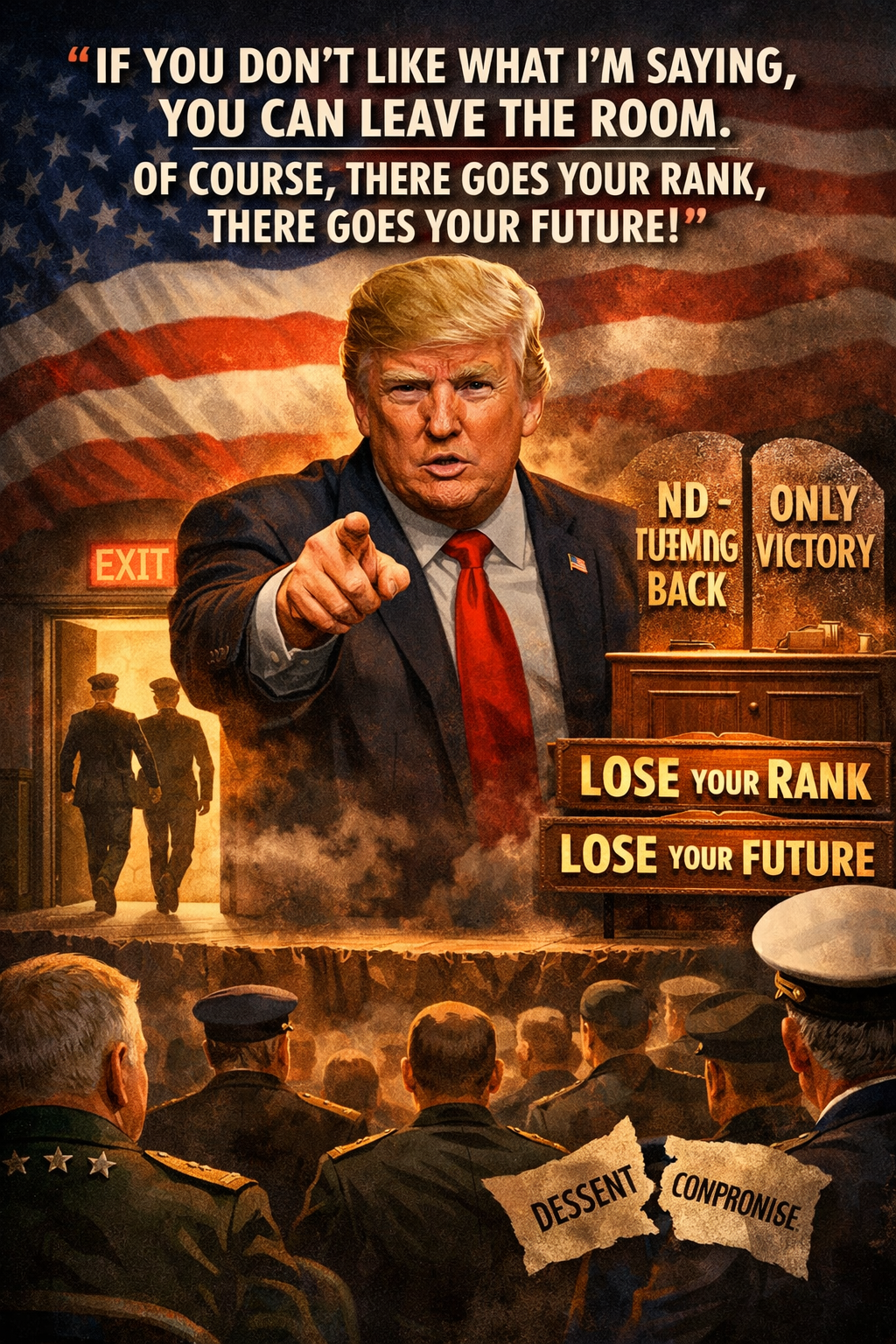
On September 30, 2025, at Marine Corps Base Quantico, Virginia, President Donald Trump stood before 800 U.S. military generals and admirals. His words were blunt, uncompromising, and laced with threat: “If you don’t like what I’m saying, you can leave the room. Of course, there goes your rank, there goes your future.”
Let’s look at this statement to better understand how Trump operates unconsciously through his Birth Survival Trance.
This was not just an offhand comment. It was a show of authority and a clear ultimatum, showing how power can take over. In that moment, Trump turned the meeting into a test of survival. Following him meant safety; disagreeing meant serious risk.
Authoritarian Mindset
When a leader becomes overwhelmed by power, they often abandon the usual steps that support making wise decisions. Instead of comparing options or considering outcomes, decisions become automatic actions aimed at maintaining control. President Trump exemplifies this behavior, as shown by his phrase, “It’s my way or the highway,” which reflects a leadership style where compromise is viewed as weakness and disagreement as betrayal. This approach fosters fear and demands unconditional surrender. A similar mindset was also enforced in the war with Iran. This reveals his inborn Survival Mechanism and traits.
Trump is Intoxicated With Power
The statement showed arrogance and a sense of being overtaken by power. It was not meant for discussion or teamwork, but for giving orders. Trump’s message was clear: “My way or the highway.” He put himself in charge, ignoring the advice of the country’s top military leaders. The generals were told to follow, not to give input. Generals are not partners in strategy but instruments of execution. The statement highlights a self-important attitude, dismissing the expertise of military leaders.
The message is “I am at the helm. My ship, my order.” This reveals that military personnel have no say other than to pick up their bags and leave or to comply with his orders. “As long as you obey me, you will receive your salaries and other perks after retirement.” This emphasizes submission and compliance, as careers, futures, and reputations are tied to loyalty. Officers fear reprisal, which erodes morale and genuine commitment.
Fair or Unfair
Like someone intoxicated, Trump’s feeling of power led him to ignore careful consideration. His decision-making process was swift, decisive, and impulsive. Once he set a goal, he wouldn’t deviate from it. Whether it was fair or not, it no longer mattered. The rule became “hook or crook”—the end justifies the means. Everyone needed to be united and cooperative to fulfill Trump’s objectives. How they achieved it was unimportant. If fair methods failed, he resorted to pressure and arm-twisting to get results.
The Taskmaster Persona
Trump’s words showed him as a strict boss: “I don’t care; my goals are of utmost importance, you have to achieve them somehow.” This is not leading by inspiring others, but by forcing them. His sense of power turns him into someone who demands results, no matter the process, ethics, or outcome.
The generals, experienced in war and planning, sat quietly. On the outside, they seemed to agree, but inside, they were divided. They understood the risks of following orders without question, but the threat was clear: “There goes your rank, there goes your future.” Fear took the place of trust, insecurity grew, and honest feedback disappeared.
The Survival Mechanism
This statement shows Trump’s survival instincts at work. In this way of thinking, every challenge feels like a threat, every compromise feels like giving up, and any disagreement feels like betrayal. The generals were not seen as partners, but as people who had to follow orders. Their futures depended on loyalty, not skill.
This survival mindset causes narrow thinking. Other options disappear, and only one path seems possible. The leader, caught up in power, keeps going until the mission is done, no matter the cost. In this state, running the government turns into a show of authority, with fear guiding the actions.
Metaphorical Frame
Imagine a ship’s captain who is overwhelmed by his own power. He tells the crew to sail into a storm, ignoring warnings about danger ahead. The crew knows the risks, but they stay quiet because they fear losing their jobs. The trip becomes about showing the captain’s control, not about keeping everyone safe. This is the danger of being controlled by power: the leader’s need to survive pushes the ship forward, even if it leads to disaster.
Conclusion
Trump’s ultimatum at Quantico was more than just arrogance; it showed how power had taken over his thinking. His decisions became quick, final, and made at any cost. The generals were not part of real decision-making, but just played roles in a show of authority. In this setting, fear stopped honest feedback, insecurity replaced open talk, and the drive for power set the tone.
The Quantico example shows how dangerous it is when a leader is overtaken by power. It’s not just about being strict; it’s about being driven by a need to control. This survival mindset is mistaken for strategy. In this state, leadership stops being about helping people and turns into a constant chase for control, where the real goal is lost, and only the drive for power remains.



0 Comments