
Decision-making is the essence of leadership. It is the core power through which a leader shapes direction and defines outcomes. Broadly, decisions fall into two distinct categories:
Emotional decisions — These are routed through the leader’s survival mechanism. In such moments, the leader is often on autopilot, reacting instinctively rather than reflectively. The decision emerges from ego, fear, or compulsion, and carries the imprint of unconscious patterns.
Practical decisions — These arise from deliberate assessment of the current situation. They involve weighing facts, considering alternatives, and often including others in the process. Practical decisions lean toward consensus, collaboration, and situational awareness.
Every decision, whether emotional or practical, provides direction. It signals how a goal must be pursued and what strategies should be developed to achieve it. Emotional decisions tend to loop the leader into their Birth Survival Trance, while practical decisions open space for adaptive strategies and shared responsibility.
In essence, decision-making is not just about choosing between options—it is about setting the trajectory of action. The leader’s choice becomes the compass, and from that compass, strategies are drawn, resources are mobilized, and the path toward the goal is carved.
This work is not about President Trump as an individual, nor is it meant to be a partisan critique. It is about the universal survival patterns revealed through his actions. Because his behavior is so publicly visible — broadcast visually and auditorily to the entire world — he serves as a vivid example. The patterns described here are not unique to him; they are human patterns, observable in leaders, communities, families, and individuals across cultures. Trump’s conduct simply provides a magnified lens through which these unconscious mechanisms can be studied and understood.
To know more about Survival Mechanisms and their traits, you can read “Stop Surviving Start Living With Freedom” and “The Self Decoded.” These works explore how our unconscious survival trance shapes decisions, behaviors, and communication — whether in personal life or on the global stage.
Most of President Trump’s decisions are made unconsciously through his Survival Mechanism, which is emotionally charged.
Centralization of Authority
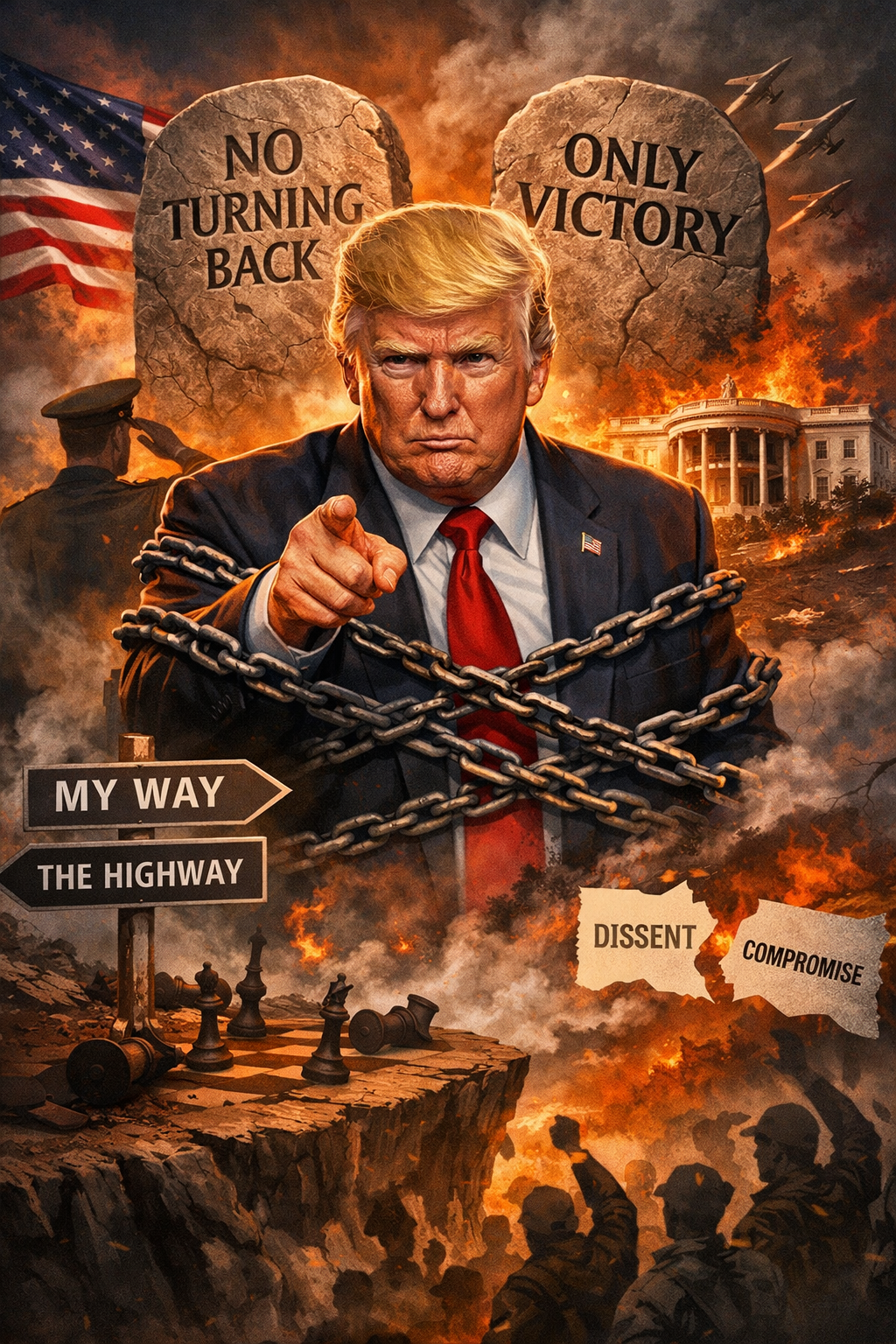
Trump’s leadership centers on keeping control. All big decisions go through him, and he puts himself at the top. His choices are not open to change or discussion. Once he decides, the decision stands, even if it’s wrong. He often acts as if his authority can’t be questioned. This approach breaks down trust in his team, as others lose independence and are left to simply carry out his orders. President Trump exemplifies this behavior, evident in his phrase, “It’s my way or the highway,” which exemplifies a leadership style that views compromise as a sign of weakness and disagreement as betrayal. This approach encourages fear and demands unconditional surrender. A similar mindset was also evident during the war with Iran. This reflects his innate Survival Mechanism and personality traits. (Refer: https://shorturl.at/uhv6H)
Lack of Trust
Every important decision needs his approval, showing he doesn’t trust those around him. Advisors, generals, and cabinet members cannot act on their own; they must repeat his orders. This lack of trust creates a fragile environment in which honest feedback is suppressed and only loyalty matters. Without trust, insecurity grows, isolating and controlling the team.
His survival mechanism prevents him from trusting others, leaving him feeling insecure and fragile. His underlying need is for everyone to trust him and demonstrate loyalty, but he has difficulty showing that. (Refer: https://shorturl.at/hkPmk)
Why His Decisions Become Irrevocable
His leadership style projects an air of irrevocability. Once a decision is made, reversing it is seen as a weakness or embarrassment. Instead of admitting error, he doubles down, framing persistence as strength and loyalty rather than reconsideration. This rigidity is his unconscious birth programming and not intentional. His Survival Mechanism (ego) forbids revocation, compelling him to fight to the end, even in the face of mounting evidence.
It’s like a train on a single track: once it leaves the station, it can’t change direction. The train picks up speed, and even if the bridge ahead is out, it doesn’t stop. This is the risk of being overtaken by power—decisions become more about showing control than about good leadership.
Several dynamics explain this pattern:
Image of infallibility: Admitting error would puncture the inflated image of dominance (Superman) that he has cultivated over the years.
Avoiding embarrassment: Reversals look weak, so he escalates rather than re-strategies. He fears that admitting mistakes will bring down his empire and end his career.
Loyalty test: Sticking with a decision, even if flawed, becomes a way to measure who remains loyal under pressure. He is safeguarding his inflated Michelin balloon image by demanding that others remain loyal to him.
Dangerous rigidity: His internal mechanism compels him to keep that posture, preventing him from getting exposed. Admitting mistakes is forbidden within his Survival Mechanism’s design. He must either escalate further or use the “hook or crook” strategy to reach his objectives. For him, his goals are non-negotiable, making change difficult. This creates a risky situation, as he might lead the team and the entire country into a downward spiral.
The risk with this style is that decisions made from a Survival Mechanism spread out and affect more than just Trump—they impact the whole country. Policies turn into fights over pride rather than plans for good government. This is his Birth Survival Trance; his decisions can’t be changed, even bad decisions continue, often causing serious harm, since admitting mistakes is not allowed.
The Survival Trance
When Trump acts from a survival mindset, his decisions are driven by impulse rather than by a careful assessment of the situation. In this state, compromise feels like giving up, disagreement feels like betrayal, and negotiation hardly happens. Problems are seen as battles to be won somehow, not as things to solve. By not listening, he becomes more isolated, which increases insecurity and distrust. This Survival Mechanism traps him in a loop: make a decision, enforce it, push harder, and keep fighting.
This survival mindset is deeply rooted in his Birth Survival Trance. It comes from ego, the need to be in control, and his fear of looking weak and being exposed. Every challenge feels like a threat. Every compromise feels like giving up. Every disagreement feels like betrayal. In this state, decisions are not about what’s best for the country, but about keeping the leader in control.
Conclusion
Trump’s decision-making reflects the thinking patterns of a leader operating from his Survival Mechanism. Putting all power in one place, not trusting others, and refusing to change decisions all add up to a strict, controlling style in which choices are made by impulse rather than through teamwork. By treating leadership as a test of loyalty and control, he turns governing into a survival contest. In this contest, compromise is seen as weakness, disagreement as betrayal, and the leader keeps fighting—not for the people, but to keep his own power.
The most troubling part is that these decisions spread far and wide. They impact millions, but are made within the limits of one person’s obsession with power. Because the decisions can’t be changed, everyone—soldiers, citizens, and even people around the world—must live with the results. Whether fair or not, the leader caught up in power won’t stop until the goal is reached.
Trump’s approach to politics shows the danger of unchecked power. It’s not just about being strict; it’s about being driven by a need to control. This survival mindset is mistaken for strategy. In this state, leading becomes less about helping people and more about showing who’s in charge. The drive for power is not just risky—it’s harmful, because it turns leadership into a never-ending chase where the real goal is lost and only the pursuit of power remains.
NOTE: Much of his behavior and communication operates as unconscious safeguards, designed to shield the fragile construct of his ego. Because the ego is an artificial projection rather than an authentic core, it compels him into patterns of defense and preservation. He acts not out of deliberate choice but as part of nature’s larger design, following instinctual currents that dictate survival. In this sense, his actions are less about intention and more about inevitability—he does what he must because the architecture of his psyche leaves him no alternative.


0 Comments