
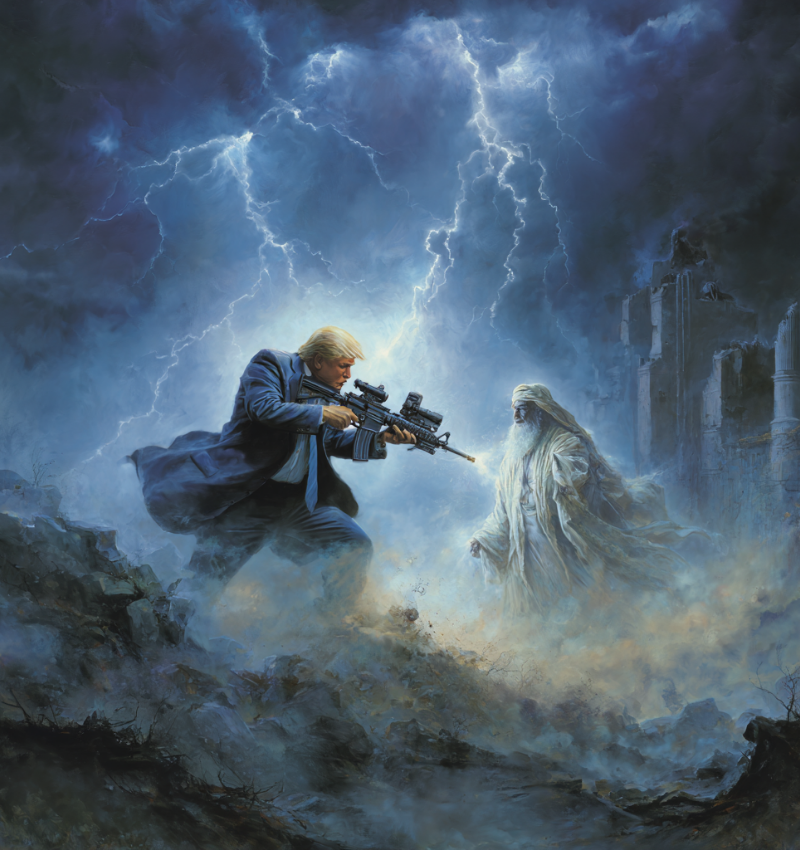
USA – Iran War – The Ghost of the Past
“I will ‘Make America Great Again’ (MAGA) by restoring lost glory.” This has been the main message of U.S. policy since Donald Trump became president for the second time. There is also an unspoken message: “If you are not for me, then you are against me. And if you are against me, you must be punished.”
Every nation functions as a unit, similar to a family, group, community, or organization, with a designated leader and their team. In such environments, it is crucial that all members follow the leader’s decisions and guidance. The leader establishes rules and laws that others must follow. This often requires individuals to modify their thoughts, beliefs, and behaviors to align with the leader’s vision and the authority of those in charge, thereby promoting unity and cohesion within the group.
This principle also extends to nations—whether monarchies, democracies, authoritarian regimes, oligarchies, theocracies, or one-party states. The future of a country is largely determined by its leader. The leader’s management style reflects their personality, encompassing behaviors, thoughts, beliefs, and communication. The country’s development and governance hinge on the leader’s choices.
Let’s examine two influential nations and their leaders: the USA and Israel. These countries are highlighted due to their recent significant actions against Iran. Analyzing them helps us gain insight into leadership approaches that notably influence global affairs, particularly in the context of the Iran conflict.
The Revolution That Changed Everything
On 11 February 1979, the Shah of Iran was overthrown. For Washington, this was more than the fall of a monarch. It meant losing a key ally, a Cold War partner, and a symbol of American influence in the Middle East. The Shah supported modernization and Westernization while keeping Soviet influence at bay. His fall hurt U.S. pride, and the hostage crisis, where American diplomats were held as prisoners, made things worse. This was not just a political loss; it was a psychological blow. America felt it had lost control, its prestige, and a strategic partner, leaving a lasting wound. For many Iranians, however, the revolution brought hope for independence and gave people the sense that their country could finally reclaim its destiny after years of foreign involvement. While the path forward was uncertain, there was a strong feeling that the revolution marked a new beginning.
Before 1979, Shah Mohammad Reza Pahlavi ruled Iran. Resentment grew after the 1953 CIA-backed coup, as many Iranians saw foreign influence as a threat to their sovereignty. The Shah ruled with an iron fist, using SAVAK (his secret police known for torture and surveillance) to silence opposition, banning political parties, and persecuting dissenters. Although Iran had oil wealth, most people faced inflation, unemployment, and poverty, while modernization mainly helped the elite and widened social gaps. Religious leaders, led by Khomeini, spoke out against Westernization and secular reforms, seeing them as a rejection of Islamic values. Khomeini’s exile made him a symbol of resistance. These problems led to the end of Iran’s monarchy after 2,500 years.
Shah – a fragile Ruler
The Shah’s reign resembled a glass palace—shiny with modern features yet propped up by foreign scaffolding. Western powers, intent on securing Iran’s oil and strategic assets, influenced his governance. Inside, landowners, industrialists, and technocrats prospered, their wealth enhanced through Western connections. However, beyond the palace walls, most Iranians saw only a monarch encased in glass, fragile and transparent, serving foreign interests instead of his own people.
The 1953 coup cemented this illusion of strength. The U.S. and Britain, determined to guard Iran’s oil and geopolitical value, reinforced the scaffolding that held the palace upright. Urban elites and landowners, who benefited from modernization, supported this structure, even as widespread resentment grew. Outwardly, the palace shimmered with stability; inwardly, its foundations were brittle, vulnerable to the tremors of discontent that would one day shatter its walls.
After the 1953 coup, the USA and Britain secretly helped restore the monarchy. The Shah became a ruler under their influence. Both countries wanted access to Iran’s energy resources and strategic position. Iranians saw through these motives, which led to a revolt that eventually overthrew the Shah.
Hidden Agendas
The USA and Britain were upset about losing their influence and control in Iran. They tried different ways to get it back, such as imposing sanctions and making life harder for Iranians. For example, in 1979 and after the 1979 hostage crisis, the United States froze nearly $12 billion of Iranian assets and initiated broad economic sanctions, which were later expanded to target Iran’s oil exports and banking sector. These measures have continued in different forms to this day, including sanctions on Iranian industries and individuals. The ongoing conflict can be seen as payback for past losses, with the aim of regaining influence, and Israel has supported this effort. For instance, Israel reportedly conducted covert operations against Iranian nuclear facilities, such as the computer virus attack on Iran’s Natanz uranium facility and alleged assassinations of Iranian nuclear scientists. Israel has also acted opportunistically, seeking to expand its power in the Middle East and waiting for the right moment.
The Shah was overthrown because his authoritarian rule, poor economic management, cultural disconnect, and reliance on foreign powers united students, workers, clerics, and nationalists into a revolutionary movement that brought his rule to an end in February 1979.
Power Means Control
For the United States, power means control, not just ownership. When a country is seen as a key target, whether for its oil, location, or symbolic value, losing it feels like a defeat. Iran under the Shah was one of these targets. When the 1979 revolution removed him, Washington lost more than an ally—it lost its hold. The sanctions, isolation, and hostility that followed were less about Iran and more about America’s unwillingness to accept this loss.
Trump’s approach reflects this mindset. Iran is once again seen as the enemy, but the real goal is to reassert dominance and show that America is still in control. The visible actions—sanctions, threats, and military moves—show an underlying fear that once dominance is lost, it cannot be regained. Elites reinforce this fear, keeping policy focused on holding on to power.
America’s approach is like holding tightly to its chosen targets, refusing to let go. The tighter the hold, the more resistance grows. When control is lost, the impact is felt both in politics and in the national mindset. The fear of losing control is what keeps these patterns repeating and drives America’s conflicts.
History Repeating
The current conflict is not entirely new; it repeats patterns from the past. The Shah’s fall, the events of 1979, and the loss of control all echo in today’s confrontations under Trump. This repetition is not just about history repeating itself. It is also about projecting past defeats into the present, shaping today’s actions as efforts to resolve old wounds.
America and Iran are not simply stuck in a cycle or free from history. Instead, the past continues to shape the present. The conflict is fought not just on the ground, but also in memory, where old patterns and projections come together and influence current events.
Restoring past glory: The U.S. lost Iran in 1979, which hurt its global reputation. This idea has stayed alive in both countries, with tactics like sanctions keeping the memory fresh.
Trump’s words and actions can be seen as an effort to regain lost dominance and show that America can still set the terms in the Middle East.
Make America Great Again by controlling Iran’s resources: Iran’s energy reserves, rare earth elements, and enriched uranium are not just economic assets—they are strategic tools. Whoever controls them can influence global markets and technology supply chains. Trump’s pressure campaign is about controlling resources as much as it is about ideology.
Geographic control: The Strait of Hormuz is a key passage, with about a fifth of the world’s oil passing through it. For the U.S., controlling this area is not just about Iran. It is about asserting power over global energy routes and ensuring rivals like China and Russia cannot take control.
America is trying to hold on to its past victories by controlling resources and geography, hoping to prevent decline. However, the tighter the hold, the more resistance grows, just as it did during the Shah’s rule.
The Ghost of the Past
The ghosts of the past still linger, and they will continue to haunt until the United States learns how to begin anew. The past cannot be changed or restored, nor can it be endlessly replayed in the present. What is required is not nostalgia but transformation—a willingness to shed the scaffolding of old, distorted perception and to think differently about power, sovereignty, and history. For the president, this shift is challenging, for his internal structures that shaped his instincts were designed differently. How those structures constrain and distort his decisions will be explored in future articles.




0 Comments