
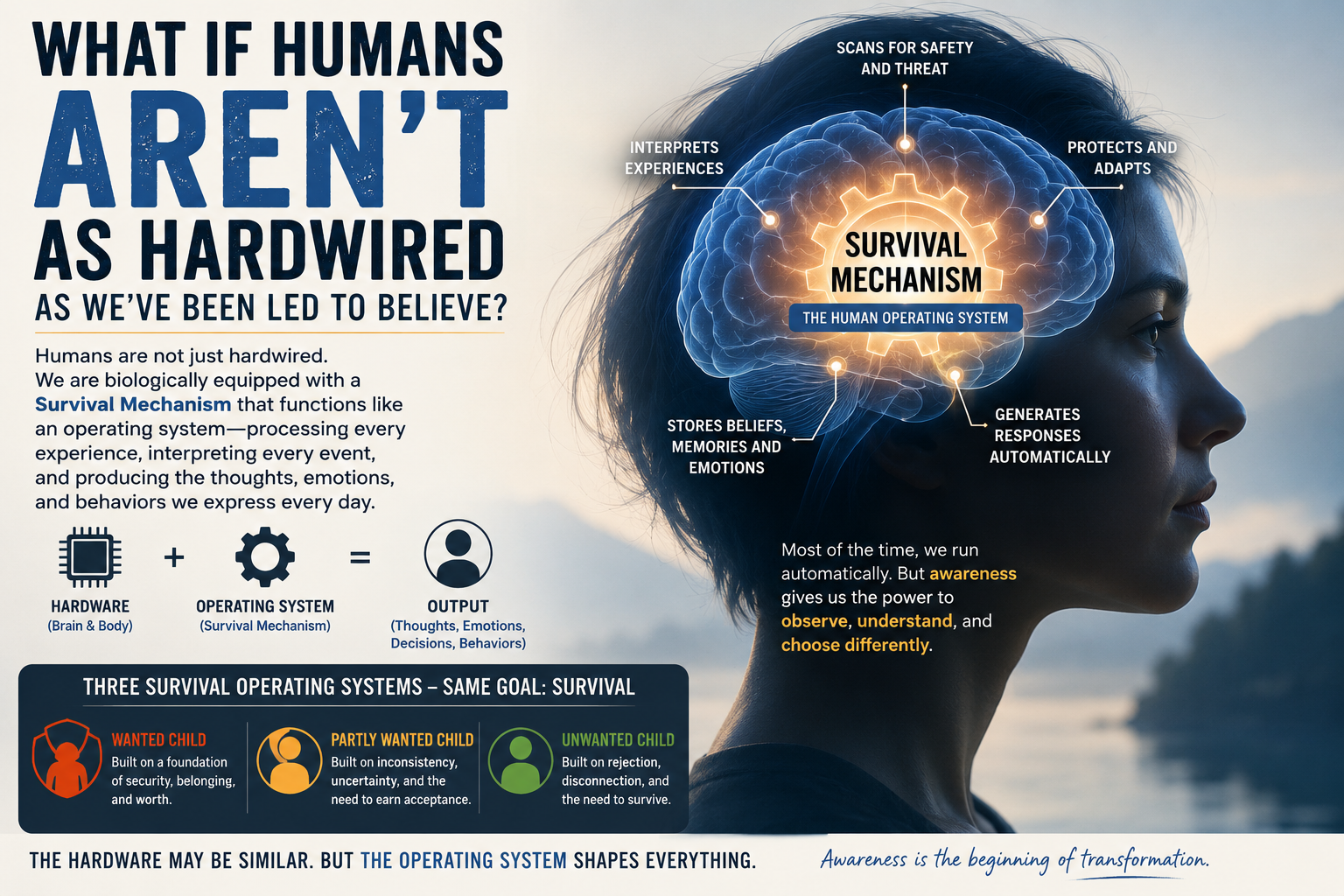
Guess what? We may not be as hardwired as we’ve been led to believe.
For decades, psychologists, neuroscientists, educators, and countless self-help authors have told us that human beings are hardwired. We are said to be hardwired for survival, attachment, fear, competition, cooperation, and countless other behaviors. The phrase has become so common that few people pause to consider what it actually means. But what if we have been asking the wrong question?
Survival Operating System
Perhaps humans are not simply hardwired. Perhaps we are biologically equipped with a survival system that functions much like an operating system—processing every experience, interpreting every event, and generating the thoughts, emotions, and behaviors we express daily.
Every computer requires hardware to perform any function. Without the processor, memory, storage, and circuits, no software can operate. Likewise, the human body and brain provide the biological hardware necessary for life. However, hardware alone does not determine how a system behaves.
Imagine purchasing three identical computers. They contain the same processor, the same memory, and the same storage capacity. Yet one runs Windows, another runs macOS, and the third runs Android. Give each computer the same input, and they may respond differently because each operating system processes information according to its own architecture. The hardware remains the same. The operating system is different. What if human beings function in a similar way?
Survival Mechanism
Perhaps our brain is the hardware, but our Survival Mechanism functions as the operating system that continuously processes every experience throughout our lives.
Every threat
Every conversation.
Every relationship.
Every criticism.
Every success.
Every risk.
Every disappointment.
Every opportunity.
These experiences become inputs. The Survival Mechanism interprets them and produces outputs in the form of thoughts, emotions, decisions, behaviors, habits, and even our perception of reality. Most of us assume these outputs represent who we truly are. But what if they simply reveal how our survival system has been programmed to function? This question becomes even more fascinating when we observe how differently people respond to identical situations.
Two children grow up in the same family. They attend the same school. They are raised by the same parents. They experience many of the same external events. Yet one becomes confident while another becomes anxious. One constantly seeks approval. Another becomes emotionally distant. One embraces change. Another fears uncertainty.
If human beings are entirely hardwired in the traditional sense, how do we explain such enormous differences?
Certainly genetics plays a role. Life experiences matter. Culture influences us. But perhaps there is another layer that deserves closer examination.
Over many years of working with people, I began to notice that individuals appeared to process reality in remarkably consistent patterns. They were not merely reacting to life; they were interpreting life through an internal survival system that filtered every experience before it reached conscious awareness.
I call this the Survival Mechanism. Its primary purpose is not happiness. It is not fulfillment. It is not self-actualization. Its primary purpose is Survival.
What must I do to survive?
Like every operating system, it constantly asks one fundamental question: “What must I do to survive?” The answer to that question varies from person to person. For one individual, survival may mean proving worthy. For another, survival may require pleasing everyone. For someone else, survival may involve staying emotionally detached, remaining in control, avoiding vulnerability, or constantly avoiding rejection.
Although the behaviors differ dramatically, they all serve the same biological objective: Survival.
This perspective also explains why logical advice often fails. We tell someone, “Don’t worry.” Yet they continue worrying. We tell another person, “Be yourself.” Yet they continue seeking approval. Someone promises not to get angry but repeatedly falls into the same patterns. The problem may not be a lack of intelligence. Instead, their Survival Mechanism continues to process reality according to the same internal programming that once helped them survive.
Like an operating system running in the background, most people are completely unaware of it. They notice only the outputs. They experience anxiety. They feel anger. They become defensive. They withdraw. They sabotage opportunities. Yet rarely do they stop to ask what invisible system produced these responses in the first place.
AI and Human Survival Mechanism
Today’s advances in artificial intelligence offer another interesting comparison. An AI system receives input. It processes that input according to the way it has been trained. It produces an output. The quality of that output depends upon the information available and the way the system processes it.
Humans appear to function similarly in many respects. We continuously receive information from the world. Our Survival Mechanism processes that information according to its programming. It generates outputs in the form of thoughts, emotions, beliefs, decisions, and behaviors. However, there is one profound difference.
Human beings possess awareness. We can become conscious of the system doing the processing. We can observe our own thoughts. We can question our beliefs. We can recognize repeating emotional patterns. We can ask ourselves why we reacted the way we did. This capacity for awareness may be one of humanity’s greatest gifts.
The Survival Mechanism operates automatically.
Awareness makes transformation possible.
When we become aware of our operating system, we are no longer completely controlled by it. We begin to distinguish between who we are and the automatic patterns that have governed us for years.
Perhaps personality is not our true identity. Perhaps it is the consistent output of a Survival Mechanism doing exactly what it was designed to do. If that possibility is true, it changes the way we understand ourselves. Instead of asking, “What’s wrong with me?” we begin asking, “What is my Survival Mechanism trying to accomplish?”
Instead of labeling people as difficult, manipulative, emotionally unavailable, controlling, or insecure, we begin asking what survival strategy their system has learned to rely upon. This shift does not excuse harmful behavior. But it does create understanding. And understanding is often the first step toward freedom.
The phrase “humans are hardwired” may still contain an important truth.
We are biologically equipped with a remarkable survival system. But perhaps the deeper question is not whether we are hardwired. Perhaps the real question is this: What kind of survival operating system are we running? Because if we can understand the system that shapes our thoughts, emotions, relationships, and decisions, we may discover that much of what we believed to be our identity is simply the output of a survival process running quietly in the background all along.
And if awareness allows us to see that process clearly, then perhaps genuine freedom begins not by changing who we are—but by understanding the system through which we have been living.



0 Comments