
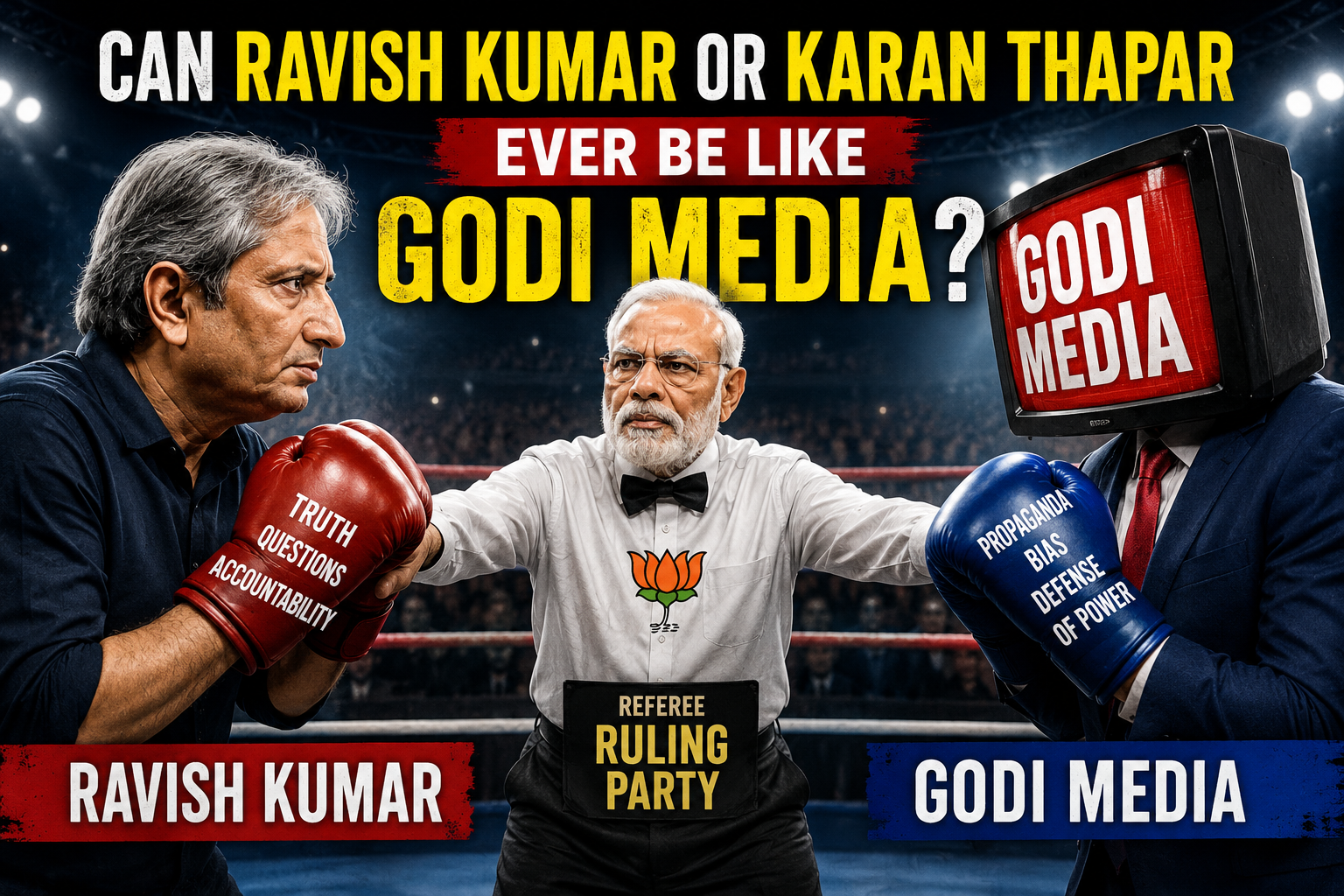
Can Ravish Kumar or Karan Thapar ever be like Godi Media? Observe what is unfolding around us. It often seems as though the country is engaged in a silent conflict, not necessarily with weapons but through competing narratives and opinions. This includes headlines, social media, speeches, debates, and contrasting realities. Amidst this chaos, journalism itself seems sharply divided. Some journalists continue to challenge those in authority, acting as watchdogs. Meanwhile, others appear increasingly aligned with the ruling powers, often labeled “Godi Media”—outlets that sit comfortably in the lap of authority. They flock together, creating a chorus so loud that dissent is drowned out.
TWO SIDES OF THE SAME WORLD
The divide spans beyond journalism to politicians, intellectuals, artists, public figures, young voices, educators, and society, but is most evident in journalism. Journalism’s crucial role in democracy is to watch, question, investigate, challenge, and hold power accountable, earning it the title of the fourth pillar of democracy. When journalists diverge greatly, the contrast is stark and evident.
On one side are journalists challenging government policies, scrutinizing authority, and questioning difficult subjects, exemplified by Ravish Kumar, Karan Thapar, Ajit Anjum, and others. The other side comprises media supporting or amplifying those in power, often called “Godi Media.” This isn’t just about political support but a pattern: some ask, “What is the government doing?” and should be questioned, while others defend or promote the government. These contrasting approaches give the public very different views of the same country.
THE SAME DIVIDE EXISTS ELSEWHERE
Beyond journalism, Indian politics is deeply divided, with politicians sometimes uniting despite past opposition. Parties split, individuals switch allegiance—some align with the ruling, others with opposition. Divisions also exist among intellectuals like Amartya Sen, Ramachandra Guha, Prakash Raj, and Sonam Wangchuk, from diverse backgrounds but often taking contrasting stances. Young voices and digital creators like Dhruv Rathee, Kunal Kamra, Khan Sir, Neha Rathod, and Abhijeet Dip-kay have built their audiences.
WATCHDOGS AND LAPDOGS
They have noticed that the master and its lapdogs prefer a single chorus — one song sung in unison, praising authority and silencing dissent. But these young voices refuse to harmonize with propaganda. They challenge, question, and provoke thought, reminding the audience that democracy thrives not in uniformity but in diversity of opinion.
While their professions, personalities, opinions, and methods differ, a recurring pattern emerges: some frequently question authority, while the lapdogs and others support it. This consistent polarity across groups prompts the question: what drives this pattern?
DAY AND NIGHT
Let’s consider an analogy from nature. Some animals are active mainly during the day, called diurnal, while others are nocturnal. Their environments, rhythms, and sensory systems differ. What helps one thrive in daylight may not work for another at night. A nocturnal animal isn’t a failed daytime animal, nor is a daytime animal a failure just because it isn’t active at night. Both have adapted to their environments. They have different ways of navigating the world. The Earth remains the same, but their experiences differ. Now, think of humans. We live in the same country, witness the same events, hear the same speeches, and experience the same economy. Despite this, people perceive reality differently: one sees danger, another sees stability; one perceives oppression, another sees order; one notices courage, another sees irresponsibility; one views a journalist asking questions, another sees an attack on the nation. How can the same event evoke such contrasting reactions?
ARE WE SIMPLY CHOOSING?
My interest is piqued here. We often label differences as left/right, government/opposition, nationalist/liberal, conservative/progressive, supporter/critic. These help but don’t answer why people choose sides. What makes one question authority or defend it? Why does one stand alone or seek group protection? Why does one tolerate criticism, whereas another attacks the critic? These recurring patterns hint at deeper human drives.
LOOK AT THE PATTERN
This isn’t about understanding what’s happening inside another person’s mind but observing their behavior, communication, reactions, and the issues they emphasize or avoid. Repeated patterns over years reveal insights about the individual, prompting us to consider if some mechanism shapes who we are and how we respond. Political divides might then reflect deeper aspects of human nature.
A COUNTRY LOST IN TWO NARRATIVES
This is where things get intriguing. We live within conflicting narratives: one urges us to question government, the other to support it. One highlights failures, the other successes. Some question authority; others dismiss critics, shaping perceptions and redirecting blame. Both sides believe they reveal the truth. As voices grow louder, ordinary people struggle to see beyond these stories, choosing sides, defending, and attacking. Eventually, these narratives merge with our identities, leaving us confused and lost in their web.
SO WHAT IS REALLY HAPPENING?
We might see a political divide caused by underlying ideological differences like ambition and fear, driven by factors such as opportunity and power. There may be two fundamental human responses—distinct patterns of communication, danger interpretation, and security pursuit. Hence, ‘watchdog’ and ‘lapdog’ could symbolize these survival strategies beyond politics. Does this suggest humans are born with innate mechanisms influencing our thoughts, actions, and reactions to authority? Could these cause different tendencies toward independence or collaboration? This might explain why people in the same country can live in different worlds. We explore this more in Part Two, where the external divide may stem from deeper internal causes.


0 Comments