
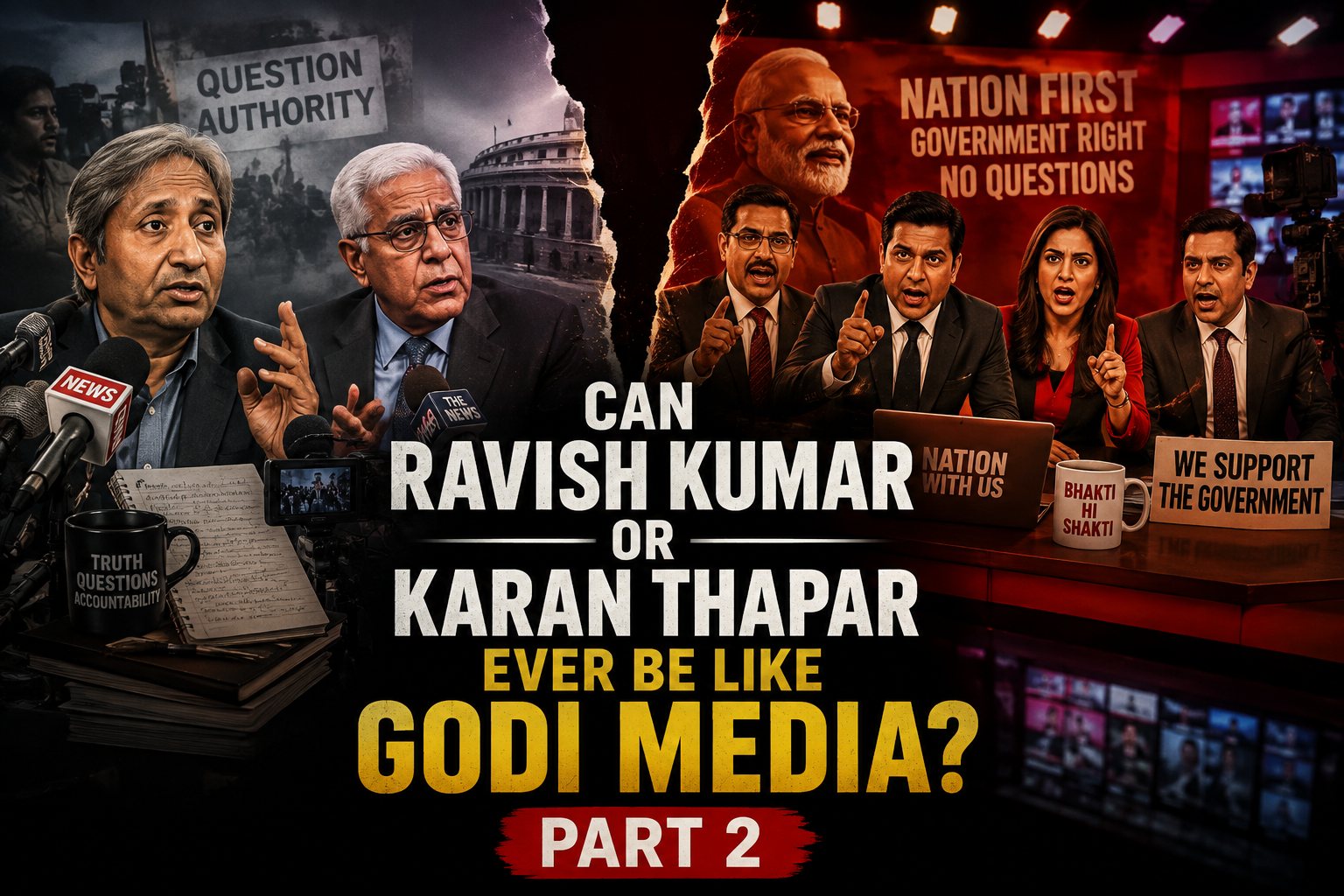
Godi Media vs Watchdogs: Survival Trap Behind Journalism’s Divide
In Part One, we explored the divide within journalism—between those who challenge authority and those who align with power. These two camps, often described as watchdogs and lapdogs (or Godi Media), reflect broader polarities in politics, intellectual circles, public life, and even everyday relationships. It often feels as though we live in two parallel worlds, each with its own narratives and realities. The question is: why do humans gravitate so strongly to one side or the other? What lies beneath this divide?
I call this deeper layer the Survival Mechanism—an inborn program that shapes our behavior, communication style, core beliefs, and responses to the world.
How Groups Reinforce Beliefs
When individuals with similar perspectives gather, they strengthen each other’s convictions. One person’s story becomes another’s evidence; criticism from one becomes proof for another. Over time, shared interpretations harden into certainties, allowing groups to construct their own realities. This dynamic is especially visible in politics and media, where some outlets echo the ruling class while others challenge it. People then select sources that affirm their worldview, dismissing the rest. As a result, two groups can perceive entirely different versions of the same country.
Survival Mechanisms as Human Architecture
Consider the analogy of daytime and nocturnal animals. Each is adapted to its environment—light or darkness—with senses and rhythms tuned for survival. Neither envies the other; each thrives in its own world. Humans are similarly born with distinct Survival Mechanisms. These mechanisms don’t dictate political beliefs at birth, but they form the foundation upon which experiences, relationships, and choices accumulate. Over time, they manifest in behavior, communication, emotional reactions, and worldview.
Thus, two children raised in similar circumstances may respond differently, and two journalists covering the same government decision may interpret it in opposite ways. Why? Because their inner survival frameworks differ.
Two Orientations: Belonging vs. Independence
One survival orientation emphasizes belonging, approval, security, and alignment. Another prioritizes independence, resistance, integrity, and questioning. Neither is morally superior; they are simply different strategies for survival. Some feel safest connected to authority, while others feel secure challenging it. Criticism may threaten one person, while conformity may suffocate another. These orientations explain why some journalists defend power while others confront it.
The Survival Mechanism is not hidden—it is visible in patterns of behavior, communication, and trust. It shows in what we defend, what we challenge, how we handle disagreement, and what risks we take. Observing recurring patterns allows us to ask: what deeper mechanism might be driving this?
Why Division Deepens
Imagine two groups: one comfortable in daylight, the other in darkness. Neither can fully operate by the other’s rules. Similarly, someone whose Survival Mechanism values alignment may find challengers incomprehensible, while an independent person may be baffled by conformity. Each perceives the other through their own survival lens, reinforcing division.
When people with similar mechanisms gather, they validate each other, forming communities and narratives. Over time, each group begins to view the other as a threat. Politicians, media, and social platforms amplify these divides, but the tendency to group and defend interests predates modern politics. Division is not created by parties—it is rooted in human survival instincts.
Journalism Through the Lens of Survival
Why do some journalists constantly question the government while others defend it? Ideology, ambition, fear, and opportunity all play roles. But beneath these lies the Survival Mechanism. It shapes what feels safe, threatening, necessary, or unacceptable. Since much of this operates unconsciously, individuals often experience it simply as: “This is what I believe.” They may genuinely hold those beliefs, unaware that deeper instincts are guiding them.
This perspective helps explain why watchdogs like Ravish Kumar or Karan Thapar are unlikely to become lapdogs. Their survival orientation is rooted in independence, questioning, and resistance. To shift into a mode of alignment and conformity would feel unnatural, even threatening. Conversely, those whose survival depends on belonging and proximity to power are unlikely to embrace watchdog roles. Change is possible, but it often feels uncomfortable because it conflicts with established survival patterns.
Beyond Right and Wrong
The watchdog-versus-lapdog debate is only the surface. Beneath it lies a deeper human question: why do we become who we are? Why do some seek approval while others value independence? Why does one person pursue authority while another challenges it? These answers are not found solely in politics or personality but in the architecture of our Survival Mechanisms.
When examining divides in journalism, politics, or even personal relationships, it helps to shift focus from “Who is right?” to “What survival instincts are shaping these actions?” Consider what people are defending, what they fear, and what they find safe or threatening. We may not be living in one shared reality but in different “worlds”—some in the day, others in the night—on the same planet, amid the same events, but through different survival lenses.
Understanding the Divide
Figures like Ravish Kumar and Karan Thapar, known for watchdog roles, are unlikely to align with Godi Media because their survival mechanisms differ fundamentally from those who support power. The same applies in reverse. The key insight is not about judging which side is better, but about recognizing that different survival mechanisms lead to different human realities.
Once we understand this, we can better comprehend both others and ourselves. Division may be inevitable, but awareness of the deeper forces shaping it allows us to engage with more empathy, clarity, and perspective.


0 Comments