
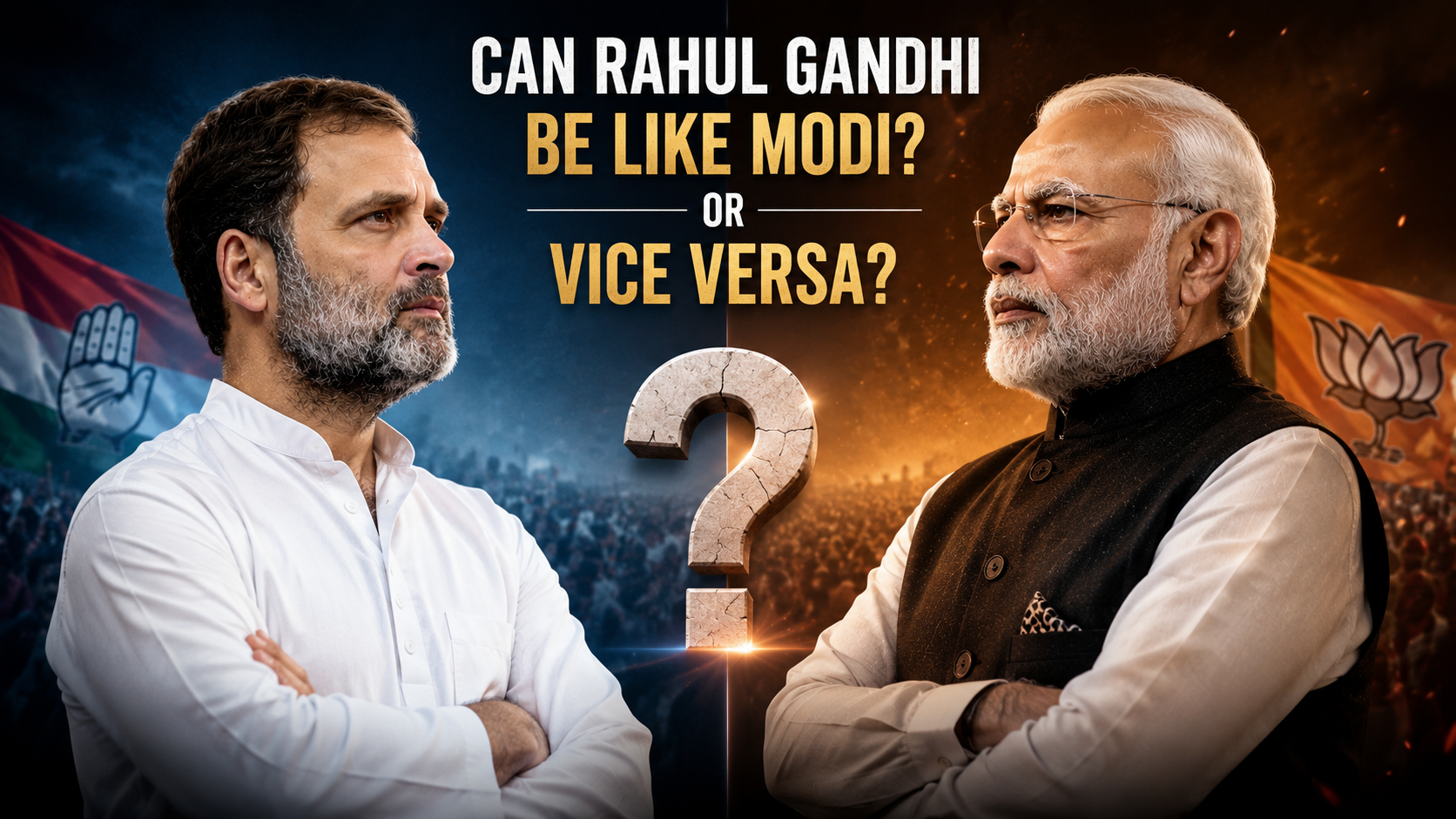
Can Rahul Gandhi ever be like Narendra Modi? And can Modi, in turn, act like Rahul Gandhi?
Rahul Gandhi vs Modi: Distinct Personalities
You have seen Rahul Gandhi. You’ve seen Narendra Modi. Additionally, you’ve noted their reactions and decision-making. You’ve heard their speeches and communication styles. Their dressing and language patterns differ. Their vision of India is different. By now, it’s clear they are two distinct personalities. The differences arise from different experiences and instincts. The question remains: can Rahul Gandhi ever be like Modi, or Modi like Rahul Gandhi?
At first glance, these questions sound almost impossible. Two leaders, two personalities, two worlds apart. Moreover, beneath the surface lies a far more intriguing question. It goes beyond politics, beyond ideology, and beyond India’s future. I’m not here to argue who is right or wrong. I’m not here to decide which ideology serves the nation better. This is not about choosing sides. Instead, let’s strip away the labels—Prime Minister, Opposition Leader, party symbols, and battles. View them as what they truly are: human beings. Before they became public figures, they were individuals. They were shaped by experiences, molded by pressures, and driven by their own survival instincts. What makes two human beings think and behave differently to the same world? What drives their responses under pressure? Why does one dominate the narrative while Rahul Gandhi resists it?
Nocturnal and Daytime Animals
Let’s consider an example from nature. Imagine two animal groups—one active during the day and the other at night. Day animals have sensory systems and behaviors suited to daylight, while nocturnal ones are adapted to darkness. Asking the nocturnal animal, “Why can’t you be like the daytime animal?” makes no sense. Or the daytime animal, “Why can’t you be like the nocturnal animal?” also makes no sense. They have different survival adaptations. They perceive the world differently, respond to threats in unique ways, and operate on different orientations. They don’t need to be like each other to survive.
Could a similar concept apply to humans? What if our personalities are expressions of something deeper, unseen, that governs our lives? Different people might develop distinct survival strategies. Asking “Why can’t Rahul Gandhi be like Modi?” is akin to asking a nocturnal animal to be daytime; it is impossible. Conversely, “Why can’t Modi be like Rahul Gandhi?” is equally misleading. Perhaps the true questions are why they are different initially and how these differing survival tactics influence their roles. When two very different survival mechanisms come into play in politics, what happens? That’s what we will examine.
However, can Rahul Gandhi “become” Modi, or Modi “become” Rahul Gandhi? My answer is simple: why should they? Expecting that is like asking a nocturnal animal to abandon its senses. It would have to live by daylight. Each has developed a Survival Mechanism reinforced by unique experiences. What looks like political style may actually be survival orientation. Persistence versus control; questioning versus assertion. Belonging versus authority—these aren’t costumes one can swap. They are deeply embedded patterns. Here’s the trap. When we see someone act differently, we rush to judge. We judge: “He’s arrogant,” “She’s weak,” “They’re courageous,” or “They’re foolish.” We confuse behavior with identity. But the better question is what mechanism drives this behavior? Understanding the underlying pattern doesn’t mean agreeing with it. It means decoding it. I can recognize a survival orientation without adopting it. I can understand someone without endorsing their views.
Indian Politics
Indian politics often frames everything as a contest. Modi versus Rahul. BJP versus Congress, government versus opposition. Winning becomes the lens. Once we enter that mindset, we stop seeing the human behind the role. Leaders become extensions of our identity. Criticism of them feels personal. Attacks on the party feel like attacks on us. That’s survival instinct at work—asking: Who protects me? Who threatens me? Who belongs to my group? But maybe we’ve been asking the wrong questions. It’s not about who is stronger or who is right. The more intriguing question is what does each person’s behavior reveal about their Survival Mechanism? And can one simply swap that mechanism for another? The answer is almost certainly no. Human behavior is not a costume. You can’t download someone else’s experiences. Or overwrite decades of conditioning overnight.
Neither Rahul Gandhi nor Narendra Modi may be consciously aware of the Survival Mechanism guiding them. Most of us aren’t. We assume everyone perceives the world the same way. We just make different choices. But that’s the illusion. We all share the same goal—survival. But the mechanisms we use to achieve it differ profoundly. That’s why two siblings can grow into radically different people. That’s why two leaders can look at the same nation and respond in completely different ways. The real question isn’t who is correct. It’s which Survival Mechanism is at work here?
Survival Orientation Differs
However, can Rahul Gandhi “become” Modi, or Modi “become” Rahul Gandhi? My answer is simple: why should they? Expecting that is like asking a nocturnal animal to abandon its senses. It would have to live by daylight. Each has developed a Survival Mechanism reinforced by unique experiences. What looks like political style may actually be survival orientation. Persistence versus control; questioning versus assertion. Belonging versus authority—these aren’t costumes one can swap. They are deeply embedded patterns. Here’s the trap. When we see someone act differently, we rush to judge. We judge: “He’s arrogant,” “She’s weak,” “They’re courageous,” or “They’re foolish.” We confuse behavior with identity. But the better question is what mechanism drives this behavior? Understanding the underlying pattern doesn’t mean agreeing with it. It means decoding it. I can recognize a survival orientation without adopting it. I can understand someone without endorsing their views.
Indian Politics
Indian politics often frames everything as a contest. Modi versus Rahul. BJP versus Congress, government versus opposition. Winning becomes the lens. Once we enter that mindset, we stop seeing the human behind the role. Leaders become extensions of our identity. Criticism of them feels personal. Attacks on the party feel like attacks on us. That’s survival instinct at work—asking: Who protects me? Who threatens me? Who belongs to my group? But maybe we’ve been asking the wrong questions. It’s not about who is stronger or who is right. The more intriguing question is what does each person’s behavior reveal about their Survival Mechanism? And can one simply swap that mechanism for another? The answer is almost certainly no. Human behavior is not a costume. You can’t download someone else’s experiences. Or overwrite decades of conditioning overnight.
Neither Rahul Gandhi nor Narendra Modi may be consciously aware of the Survival Mechanism guiding them. Most of us aren’t. We assume everyone perceives the world the same way. We just make different choices. But that’s the illusion. We all share the same goal—survival. But the mechanisms we use to achieve it differ profoundly. That’s why two siblings can grow into radically different people. That’s why two leaders can look at the same nation and respond in completely different ways. The real question isn’t who is correct. It’s which Survival Mechanism is at work here?
[/et_pb_text][/et_pb_column][/et_pb_row][/et_pb_section]The Survival Mechanism isn’t tied to wealth, gender, or nationality. It’s rooted in birth circumstances and shaped by experiences. In my framework, there are three broad categories—not judgments, not accusations, but orientations. Each is simply a different way of navigating survival. The strategies vary—seeking safety, power, belonging, relevance—but the goal is always the same: Survival.Now, what does this have to do with Rahul Gandhi and Narendra Modi? Everything. Both are part of nature, both shaped by decades of public life. Their speeches, interviews, campaigns, reactions to criticism, and responses under pressure give us a wealth of observable data. I don’t claim to read their minds, but repeated behavior reveals patterns. And patterns, when viewed through the lens of the Survival Mechanism, tell us a great deal.
Two orientations. Two realities.
Consider the analogy. Nocturnal animals perceive reality through their own filter. Darkness shapes their adaptation; senses, instincts, and survival strategies thrive in the night. Daytime animals orient to light. Their vision and energy rhythms suit clarity and exposure. Two orientations. Two realities. Both valid and both necessary. Moreover, this isn’t just about animals. Humans adapt similarly through Survival Mechanisms. A nocturnal creature and a daytime creature share the planet, yet experience it differently. Similarly, two humans hear the same words but interpret them differently. One hears criticism, another hears feedback. One sees opportunity, another sees danger. One views compromise as intelligence, another as weakness. The same event yields two different responses. Each is filtered through a distinct survival program.
Survival Orientation Differs
However, can Rahul Gandhi “become” Modi, or Modi “become” Rahul Gandhi? My answer is simple: why should they? Expecting that is like asking a nocturnal animal to abandon its senses. It would have to live by daylight. Each has developed a Survival Mechanism reinforced by unique experiences. What looks like political style may actually be survival orientation. Persistence versus control; questioning versus assertion. Belonging versus authority—these aren’t costumes one can swap. They are deeply embedded patterns. Here’s the trap. When we see someone act differently, we rush to judge. We judge: “He’s arrogant,” “She’s weak,” “They’re courageous,” or “They’re foolish.” We confuse behavior with identity. But the better question is what mechanism drives this behavior? Understanding the underlying pattern doesn’t mean agreeing with it. It means decoding it. I can recognize a survival orientation without adopting it. I can understand someone without endorsing their views.
Indian Politics
Indian politics often frames everything as a contest. Modi versus Rahul. BJP versus Congress, government versus opposition. Winning becomes the lens. Once we enter that mindset, we stop seeing the human behind the role. Leaders become extensions of our identity. Criticism of them feels personal. Attacks on the party feel like attacks on us. That’s survival instinct at work—asking: Who protects me? Who threatens me? Who belongs to my group? But maybe we’ve been asking the wrong questions. It’s not about who is stronger or who is right. The more intriguing question is what does each person’s behavior reveal about their Survival Mechanism? And can one simply swap that mechanism for another? The answer is almost certainly no. Human behavior is not a costume. You can’t download someone else’s experiences. Or overwrite decades of conditioning overnight.
Neither Rahul Gandhi nor Narendra Modi may be consciously aware of the Survival Mechanism guiding them. Most of us aren’t. We assume everyone perceives the world the same way. We just make different choices. But that’s the illusion. We all share the same goal—survival. But the mechanisms we use to achieve it differ profoundly. That’s why two siblings can grow into radically different people. That’s why two leaders can look at the same nation and respond in completely different ways. The real question isn’t who is correct. It’s which Survival Mechanism is at work here?
[/et_pb_text][/et_pb_column][/et_pb_row][/et_pb_section]Your behaviors, your core beliefs, your values, your communication style, even the way you think—these have remained remarkably consistent over time. That consistency points to something deeper at work. Maybe you don’t consciously know what it is, because you’ve come to identify with it. You say, “This is who I am.” But beneath that identity lies a hidden program—your Survival Mechanism.And that’s exactly what I’m talking about when I refer to leaders like Rahul Gandhi and Narendra Modi. Their differences aren’t just about politics, ideology, or strategy. They stem from the deeper survival patterns that shape how each of them perceives reality, responds to pressure, and communicates with the world.
Different Survival Mechanisms
The Survival Mechanism isn’t tied to wealth, gender, or nationality. It’s rooted in birth circumstances and shaped by experiences. In my framework, there are three broad categories—not judgments, not accusations, but orientations. Each is simply a different way of navigating survival. The strategies vary—seeking safety, power, belonging, relevance—but the goal is always the same: Survival.
Now, what does this have to do with Rahul Gandhi and Narendra Modi? Everything. Both are part of nature, both shaped by decades of public life. Their speeches, interviews, campaigns, reactions to criticism, and responses under pressure give us a wealth of observable data. I don’t claim to read their minds, but repeated behavior reveals patterns. And patterns, when viewed through the lens of the Survival Mechanism, tell us a great deal.
Two orientations. Two realities.
Consider the analogy. Nocturnal animals perceive reality through their own filter. Darkness shapes their adaptation; senses, instincts, and survival strategies thrive in the night. Daytime animals orient to light. Their vision and energy rhythms suit clarity and exposure. Two orientations. Two realities. Both valid and both necessary. Moreover, this isn’t just about animals. Humans adapt similarly through Survival Mechanisms. A nocturnal creature and a daytime creature share the planet, yet experience it differently. Similarly, two humans hear the same words but interpret them differently. One hears criticism, another hears feedback. One sees opportunity, another sees danger. One views compromise as intelligence, another as weakness. The same event yields two different responses. Each is filtered through a distinct survival program.
Survival Orientation Differs
However, can Rahul Gandhi “become” Modi, or Modi “become” Rahul Gandhi? My answer is simple: why should they? Expecting that is like asking a nocturnal animal to abandon its senses. It would have to live by daylight. Each has developed a Survival Mechanism reinforced by unique experiences. What looks like political style may actually be survival orientation. Persistence versus control; questioning versus assertion. Belonging versus authority—these aren’t costumes one can swap. They are deeply embedded patterns. Here’s the trap. When we see someone act differently, we rush to judge. We judge: “He’s arrogant,” “She’s weak,” “They’re courageous,” or “They’re foolish.” We confuse behavior with identity. But the better question is what mechanism drives this behavior? Understanding the underlying pattern doesn’t mean agreeing with it. It means decoding it. I can recognize a survival orientation without adopting it. I can understand someone without endorsing their views.
Indian Politics
Indian politics often frames everything as a contest. Modi versus Rahul. BJP versus Congress, government versus opposition. Winning becomes the lens. Once we enter that mindset, we stop seeing the human behind the role. Leaders become extensions of our identity. Criticism of them feels personal. Attacks on the party feel like attacks on us. That’s survival instinct at work—asking: Who protects me? Who threatens me? Who belongs to my group? But maybe we’ve been asking the wrong questions. It’s not about who is stronger or who is right. The more intriguing question is what does each person’s behavior reveal about their Survival Mechanism? And can one simply swap that mechanism for another? The answer is almost certainly no. Human behavior is not a costume. You can’t download someone else’s experiences. Or overwrite decades of conditioning overnight.
Neither Rahul Gandhi nor Narendra Modi may be consciously aware of the Survival Mechanism guiding them. Most of us aren’t. We assume everyone perceives the world the same way. We just make different choices. But that’s the illusion. We all share the same goal—survival. But the mechanisms we use to achieve it differ profoundly. That’s why two siblings can grow into radically different people. That’s why two leaders can look at the same nation and respond in completely different ways. The real question isn’t who is correct. It’s which Survival Mechanism is at work here?
[/et_pb_text][/et_pb_column][/et_pb_row][/et_pb_section]In my model of the Survival Mechanism, these patterns don’t appear by chance. They are inborn orientations—programs that evolve through life experiences until they become so ingrained that we call them personality, character, leadership style, ideology, or simply “the way someone is.” But what if beneath all these labels lies something invisible? A deeper mechanism quietly shaping how we survive, adapt, and respond. That’s what I call the Survival Mechanism.To understand this, let’s step away from politics for a moment. Think of nature. The Earth cycles through morning, day, evening, and night—and life adapts accordingly. Some creatures thrive in daylight, others in darkness, and some in the twilight between. Nature doesn’t give every species the same abilities; it designs diversity because survival demands different adaptations.
Humans are no different because we are part of nature. We often categorize people by gender, nationality, or social class, but these don’t explain why two siblings—raised in the same home, eating the same food, attending the same school—can turn out so radically different. One seeks approval, another resists authority. One avoids conflict, another confronts it. One craves recognition, another is indifferent. These differences aren’t random; they are survival patterns.
Core Personality Remains Consistent
Your behaviors, your core beliefs, your values, your communication style, even the way you think—these have remained remarkably consistent over time. That consistency points to something deeper at work. Maybe you don’t consciously know what it is, because you’ve come to identify with it. You say, “This is who I am.” But beneath that identity lies a hidden program—your Survival Mechanism.
And that’s exactly what I’m talking about when I refer to leaders like Rahul Gandhi and Narendra Modi. Their differences aren’t just about politics, ideology, or strategy. They stem from the deeper survival patterns that shape how each of them perceives reality, responds to pressure, and communicates with the world.
Different Survival Mechanisms
The Survival Mechanism isn’t tied to wealth, gender, or nationality. It’s rooted in birth circumstances and shaped by experiences. In my framework, there are three broad categories—not judgments, not accusations, but orientations. Each is simply a different way of navigating survival. The strategies vary—seeking safety, power, belonging, relevance—but the goal is always the same: Survival.
Now, what does this have to do with Rahul Gandhi and Narendra Modi? Everything. Both are part of nature, both shaped by decades of public life. Their speeches, interviews, campaigns, reactions to criticism, and responses under pressure give us a wealth of observable data. I don’t claim to read their minds, but repeated behavior reveals patterns. And patterns, when viewed through the lens of the Survival Mechanism, tell us a great deal.
Two orientations. Two realities.
Consider the analogy. Nocturnal animals perceive reality through their own filter. Darkness shapes their adaptation; senses, instincts, and survival strategies thrive in the night. Daytime animals orient to light. Their vision and energy rhythms suit clarity and exposure. Two orientations. Two realities. Both valid and both necessary. Moreover, this isn’t just about animals. Humans adapt similarly through Survival Mechanisms. A nocturnal creature and a daytime creature share the planet, yet experience it differently. Similarly, two humans hear the same words but interpret them differently. One hears criticism, another hears feedback. One sees opportunity, another sees danger. One views compromise as intelligence, another as weakness. The same event yields two different responses. Each is filtered through a distinct survival program.
Survival Orientation Differs
However, can Rahul Gandhi “become” Modi, or Modi “become” Rahul Gandhi? My answer is simple: why should they? Expecting that is like asking a nocturnal animal to abandon its senses. It would have to live by daylight. Each has developed a Survival Mechanism reinforced by unique experiences. What looks like political style may actually be survival orientation. Persistence versus control; questioning versus assertion. Belonging versus authority—these aren’t costumes one can swap. They are deeply embedded patterns. Here’s the trap. When we see someone act differently, we rush to judge. We judge: “He’s arrogant,” “She’s weak,” “They’re courageous,” or “They’re foolish.” We confuse behavior with identity. But the better question is what mechanism drives this behavior? Understanding the underlying pattern doesn’t mean agreeing with it. It means decoding it. I can recognize a survival orientation without adopting it. I can understand someone without endorsing their views.
Indian Politics
Indian politics often frames everything as a contest. Modi versus Rahul. BJP versus Congress, government versus opposition. Winning becomes the lens. Once we enter that mindset, we stop seeing the human behind the role. Leaders become extensions of our identity. Criticism of them feels personal. Attacks on the party feel like attacks on us. That’s survival instinct at work—asking: Who protects me? Who threatens me? Who belongs to my group? But maybe we’ve been asking the wrong questions. It’s not about who is stronger or who is right. The more intriguing question is what does each person’s behavior reveal about their Survival Mechanism? And can one simply swap that mechanism for another? The answer is almost certainly no. Human behavior is not a costume. You can’t download someone else’s experiences. Or overwrite decades of conditioning overnight.
Neither Rahul Gandhi nor Narendra Modi may be consciously aware of the Survival Mechanism guiding them. Most of us aren’t. We assume everyone perceives the world the same way. We just make different choices. But that’s the illusion. We all share the same goal—survival. But the mechanisms we use to achieve it differ profoundly. That’s why two siblings can grow into radically different people. That’s why two leaders can look at the same nation and respond in completely different ways. The real question isn’t who is correct. It’s which Survival Mechanism is at work here?
[/et_pb_text][/et_pb_column][/et_pb_row][/et_pb_section]Their differences are not just political, but profoundly human.Defines your Whole Personality
In my model of the Survival Mechanism, these patterns don’t appear by chance. They are inborn orientations—programs that evolve through life experiences until they become so ingrained that we call them personality, character, leadership style, ideology, or simply “the way someone is.” But what if beneath all these labels lies something invisible? A deeper mechanism quietly shaping how we survive, adapt, and respond. That’s what I call the Survival Mechanism.
To understand this, let’s step away from politics for a moment. Think of nature. The Earth cycles through morning, day, evening, and night—and life adapts accordingly. Some creatures thrive in daylight, others in darkness, and some in the twilight between. Nature doesn’t give every species the same abilities; it designs diversity because survival demands different adaptations.
Humans are no different because we are part of nature. We often categorize people by gender, nationality, or social class, but these don’t explain why two siblings—raised in the same home, eating the same food, attending the same school—can turn out so radically different. One seeks approval, another resists authority. One avoids conflict, another confronts it. One craves recognition, another is indifferent. These differences aren’t random; they are survival patterns.
Core Personality Remains Consistent
Your behaviors, your core beliefs, your values, your communication style, even the way you think—these have remained remarkably consistent over time. That consistency points to something deeper at work. Maybe you don’t consciously know what it is, because you’ve come to identify with it. You say, “This is who I am.” But beneath that identity lies a hidden program—your Survival Mechanism.
And that’s exactly what I’m talking about when I refer to leaders like Rahul Gandhi and Narendra Modi. Their differences aren’t just about politics, ideology, or strategy. They stem from the deeper survival patterns that shape how each of them perceives reality, responds to pressure, and communicates with the world.
Different Survival Mechanisms
The Survival Mechanism isn’t tied to wealth, gender, or nationality. It’s rooted in birth circumstances and shaped by experiences. In my framework, there are three broad categories—not judgments, not accusations, but orientations. Each is simply a different way of navigating survival. The strategies vary—seeking safety, power, belonging, relevance—but the goal is always the same: Survival.
Now, what does this have to do with Rahul Gandhi and Narendra Modi? Everything. Both are part of nature, both shaped by decades of public life. Their speeches, interviews, campaigns, reactions to criticism, and responses under pressure give us a wealth of observable data. I don’t claim to read their minds, but repeated behavior reveals patterns. And patterns, when viewed through the lens of the Survival Mechanism, tell us a great deal.
Two orientations. Two realities.
Consider the analogy. Nocturnal animals perceive reality through their own filter. Darkness shapes their adaptation; senses, instincts, and survival strategies thrive in the night. Daytime animals orient to light. Their vision and energy rhythms suit clarity and exposure. Two orientations. Two realities. Both valid and both necessary. Moreover, this isn’t just about animals. Humans adapt similarly through Survival Mechanisms. A nocturnal creature and a daytime creature share the planet, yet experience it differently. Similarly, two humans hear the same words but interpret them differently. One hears criticism, another hears feedback. One sees opportunity, another sees danger. One views compromise as intelligence, another as weakness. The same event yields two different responses. Each is filtered through a distinct survival program.
Survival Orientation Differs
However, can Rahul Gandhi “become” Modi, or Modi “become” Rahul Gandhi? My answer is simple: why should they? Expecting that is like asking a nocturnal animal to abandon its senses. It would have to live by daylight. Each has developed a Survival Mechanism reinforced by unique experiences. What looks like political style may actually be survival orientation. Persistence versus control; questioning versus assertion. Belonging versus authority—these aren’t costumes one can swap. They are deeply embedded patterns. Here’s the trap. When we see someone act differently, we rush to judge. We judge: “He’s arrogant,” “She’s weak,” “They’re courageous,” or “They’re foolish.” We confuse behavior with identity. But the better question is what mechanism drives this behavior? Understanding the underlying pattern doesn’t mean agreeing with it. It means decoding it. I can recognize a survival orientation without adopting it. I can understand someone without endorsing their views.
Indian Politics
Indian politics often frames everything as a contest. Modi versus Rahul. BJP versus Congress, government versus opposition. Winning becomes the lens. Once we enter that mindset, we stop seeing the human behind the role. Leaders become extensions of our identity. Criticism of them feels personal. Attacks on the party feel like attacks on us. That’s survival instinct at work—asking: Who protects me? Who threatens me? Who belongs to my group? But maybe we’ve been asking the wrong questions. It’s not about who is stronger or who is right. The more intriguing question is what does each person’s behavior reveal about their Survival Mechanism? And can one simply swap that mechanism for another? The answer is almost certainly no. Human behavior is not a costume. You can’t download someone else’s experiences. Or overwrite decades of conditioning overnight.
Neither Rahul Gandhi nor Narendra Modi may be consciously aware of the Survival Mechanism guiding them. Most of us aren’t. We assume everyone perceives the world the same way. We just make different choices. But that’s the illusion. We all share the same goal—survival. But the mechanisms we use to achieve it differ profoundly. That’s why two siblings can grow into radically different people. That’s why two leaders can look at the same nation and respond in completely different ways. The real question isn’t who is correct. It’s which Survival Mechanism is at work here?
[/et_pb_text][/et_pb_column][/et_pb_row][/et_pb_section]Ultimately, this shows why Rahul Gandhi and Narendra Modi can never become each other. Their differences are not just political, but profoundly human.Defines your Whole Personality
In my model of the Survival Mechanism, these patterns don’t appear by chance. They are inborn orientations—programs that evolve through life experiences until they become so ingrained that we call them personality, character, leadership style, ideology, or simply “the way someone is.” But what if beneath all these labels lies something invisible? A deeper mechanism quietly shaping how we survive, adapt, and respond. That’s what I call the Survival Mechanism.
To understand this, let’s step away from politics for a moment. Think of nature. The Earth cycles through morning, day, evening, and night—and life adapts accordingly. Some creatures thrive in daylight, others in darkness, and some in the twilight between. Nature doesn’t give every species the same abilities; it designs diversity because survival demands different adaptations.
Humans are no different because we are part of nature. We often categorize people by gender, nationality, or social class, but these don’t explain why two siblings—raised in the same home, eating the same food, attending the same school—can turn out so radically different. One seeks approval, another resists authority. One avoids conflict, another confronts it. One craves recognition, another is indifferent. These differences aren’t random; they are survival patterns.
Core Personality Remains Consistent
Your behaviors, your core beliefs, your values, your communication style, even the way you think—these have remained remarkably consistent over time. That consistency points to something deeper at work. Maybe you don’t consciously know what it is, because you’ve come to identify with it. You say, “This is who I am.” But beneath that identity lies a hidden program—your Survival Mechanism.
And that’s exactly what I’m talking about when I refer to leaders like Rahul Gandhi and Narendra Modi. Their differences aren’t just about politics, ideology, or strategy. They stem from the deeper survival patterns that shape how each of them perceives reality, responds to pressure, and communicates with the world.
Different Survival Mechanisms
The Survival Mechanism isn’t tied to wealth, gender, or nationality. It’s rooted in birth circumstances and shaped by experiences. In my framework, there are three broad categories—not judgments, not accusations, but orientations. Each is simply a different way of navigating survival. The strategies vary—seeking safety, power, belonging, relevance—but the goal is always the same: Survival.
Now, what does this have to do with Rahul Gandhi and Narendra Modi? Everything. Both are part of nature, both shaped by decades of public life. Their speeches, interviews, campaigns, reactions to criticism, and responses under pressure give us a wealth of observable data. I don’t claim to read their minds, but repeated behavior reveals patterns. And patterns, when viewed through the lens of the Survival Mechanism, tell us a great deal.
Two orientations. Two realities.
Consider the analogy. Nocturnal animals perceive reality through their own filter. Darkness shapes their adaptation; senses, instincts, and survival strategies thrive in the night. Daytime animals orient to light. Their vision and energy rhythms suit clarity and exposure. Two orientations. Two realities. Both valid and both necessary. Moreover, this isn’t just about animals. Humans adapt similarly through Survival Mechanisms. A nocturnal creature and a daytime creature share the planet, yet experience it differently. Similarly, two humans hear the same words but interpret them differently. One hears criticism, another hears feedback. One sees opportunity, another sees danger. One views compromise as intelligence, another as weakness. The same event yields two different responses. Each is filtered through a distinct survival program.
Survival Orientation Differs
However, can Rahul Gandhi “become” Modi, or Modi “become” Rahul Gandhi? My answer is simple: why should they? Expecting that is like asking a nocturnal animal to abandon its senses. It would have to live by daylight. Each has developed a Survival Mechanism reinforced by unique experiences. What looks like political style may actually be survival orientation. Persistence versus control; questioning versus assertion. Belonging versus authority—these aren’t costumes one can swap. They are deeply embedded patterns. Here’s the trap. When we see someone act differently, we rush to judge. We judge: “He’s arrogant,” “She’s weak,” “They’re courageous,” or “They’re foolish.” We confuse behavior with identity. But the better question is what mechanism drives this behavior? Understanding the underlying pattern doesn’t mean agreeing with it. It means decoding it. I can recognize a survival orientation without adopting it. I can understand someone without endorsing their views.
Indian Politics
Indian politics often frames everything as a contest. Modi versus Rahul. BJP versus Congress, government versus opposition. Winning becomes the lens. Once we enter that mindset, we stop seeing the human behind the role. Leaders become extensions of our identity. Criticism of them feels personal. Attacks on the party feel like attacks on us. That’s survival instinct at work—asking: Who protects me? Who threatens me? Who belongs to my group? But maybe we’ve been asking the wrong questions. It’s not about who is stronger or who is right. The more intriguing question is what does each person’s behavior reveal about their Survival Mechanism? And can one simply swap that mechanism for another? The answer is almost certainly no. Human behavior is not a costume. You can’t download someone else’s experiences. Or overwrite decades of conditioning overnight.
Neither Rahul Gandhi nor Narendra Modi may be consciously aware of the Survival Mechanism guiding them. Most of us aren’t. We assume everyone perceives the world the same way. We just make different choices. But that’s the illusion. We all share the same goal—survival. But the mechanisms we use to achieve it differ profoundly. That’s why two siblings can grow into radically different people. That’s why two leaders can look at the same nation and respond in completely different ways. The real question isn’t who is correct. It’s which Survival Mechanism is at work here?
[/et_pb_text][/et_pb_column][/et_pb_row][/et_pb_section]When we place these patterns under the lens of the Survival Mechanism, something extraordinary begins to unfold. Ultimately, this shows why Rahul Gandhi and Narendra Modi can never become each other. Their differences are not just political, but profoundly human.Defines your Whole Personality
In my model of the Survival Mechanism, these patterns don’t appear by chance. They are inborn orientations—programs that evolve through life experiences until they become so ingrained that we call them personality, character, leadership style, ideology, or simply “the way someone is.” But what if beneath all these labels lies something invisible? A deeper mechanism quietly shaping how we survive, adapt, and respond. That’s what I call the Survival Mechanism.
To understand this, let’s step away from politics for a moment. Think of nature. The Earth cycles through morning, day, evening, and night—and life adapts accordingly. Some creatures thrive in daylight, others in darkness, and some in the twilight between. Nature doesn’t give every species the same abilities; it designs diversity because survival demands different adaptations.
Humans are no different because we are part of nature. We often categorize people by gender, nationality, or social class, but these don’t explain why two siblings—raised in the same home, eating the same food, attending the same school—can turn out so radically different. One seeks approval, another resists authority. One avoids conflict, another confronts it. One craves recognition, another is indifferent. These differences aren’t random; they are survival patterns.
Core Personality Remains Consistent
Your behaviors, your core beliefs, your values, your communication style, even the way you think—these have remained remarkably consistent over time. That consistency points to something deeper at work. Maybe you don’t consciously know what it is, because you’ve come to identify with it. You say, “This is who I am.” But beneath that identity lies a hidden program—your Survival Mechanism.
And that’s exactly what I’m talking about when I refer to leaders like Rahul Gandhi and Narendra Modi. Their differences aren’t just about politics, ideology, or strategy. They stem from the deeper survival patterns that shape how each of them perceives reality, responds to pressure, and communicates with the world.
Different Survival Mechanisms
The Survival Mechanism isn’t tied to wealth, gender, or nationality. It’s rooted in birth circumstances and shaped by experiences. In my framework, there are three broad categories—not judgments, not accusations, but orientations. Each is simply a different way of navigating survival. The strategies vary—seeking safety, power, belonging, relevance—but the goal is always the same: Survival.
Now, what does this have to do with Rahul Gandhi and Narendra Modi? Everything. Both are part of nature, both shaped by decades of public life. Their speeches, interviews, campaigns, reactions to criticism, and responses under pressure give us a wealth of observable data. I don’t claim to read their minds, but repeated behavior reveals patterns. And patterns, when viewed through the lens of the Survival Mechanism, tell us a great deal.
Two orientations. Two realities.
Consider the analogy. Nocturnal animals perceive reality through their own filter. Darkness shapes their adaptation; senses, instincts, and survival strategies thrive in the night. Daytime animals orient to light. Their vision and energy rhythms suit clarity and exposure. Two orientations. Two realities. Both valid and both necessary. Moreover, this isn’t just about animals. Humans adapt similarly through Survival Mechanisms. A nocturnal creature and a daytime creature share the planet, yet experience it differently. Similarly, two humans hear the same words but interpret them differently. One hears criticism, another hears feedback. One sees opportunity, another sees danger. One views compromise as intelligence, another as weakness. The same event yields two different responses. Each is filtered through a distinct survival program.
Survival Orientation Differs
However, can Rahul Gandhi “become” Modi, or Modi “become” Rahul Gandhi? My answer is simple: why should they? Expecting that is like asking a nocturnal animal to abandon its senses. It would have to live by daylight. Each has developed a Survival Mechanism reinforced by unique experiences. What looks like political style may actually be survival orientation. Persistence versus control; questioning versus assertion. Belonging versus authority—these aren’t costumes one can swap. They are deeply embedded patterns. Here’s the trap. When we see someone act differently, we rush to judge. We judge: “He’s arrogant,” “She’s weak,” “They’re courageous,” or “They’re foolish.” We confuse behavior with identity. But the better question is what mechanism drives this behavior? Understanding the underlying pattern doesn’t mean agreeing with it. It means decoding it. I can recognize a survival orientation without adopting it. I can understand someone without endorsing their views.
Indian Politics
Indian politics often frames everything as a contest. Modi versus Rahul. BJP versus Congress, government versus opposition. Winning becomes the lens. Once we enter that mindset, we stop seeing the human behind the role. Leaders become extensions of our identity. Criticism of them feels personal. Attacks on the party feel like attacks on us. That’s survival instinct at work—asking: Who protects me? Who threatens me? Who belongs to my group? But maybe we’ve been asking the wrong questions. It’s not about who is stronger or who is right. The more intriguing question is what does each person’s behavior reveal about their Survival Mechanism? And can one simply swap that mechanism for another? The answer is almost certainly no. Human behavior is not a costume. You can’t download someone else’s experiences. Or overwrite decades of conditioning overnight.
Neither Rahul Gandhi nor Narendra Modi may be consciously aware of the Survival Mechanism guiding them. Most of us aren’t. We assume everyone perceives the world the same way. We just make different choices. But that’s the illusion. We all share the same goal—survival. But the mechanisms we use to achieve it differ profoundly. That’s why two siblings can grow into radically different people. That’s why two leaders can look at the same nation and respond in completely different ways. The real question isn’t who is correct. It’s which Survival Mechanism is at work here?
[/et_pb_text][/et_pb_column][/et_pb_row][/et_pb_section]But I am observing what they consistently show us through their behavior. When we place these patterns under the lens of the Survival Mechanism, something extraordinary begins to unfold. Ultimately, this shows why Rahul Gandhi and Narendra Modi can never become each other. Their differences are not just political, but profoundly human.Defines your Whole Personality
In my model of the Survival Mechanism, these patterns don’t appear by chance. They are inborn orientations—programs that evolve through life experiences until they become so ingrained that we call them personality, character, leadership style, ideology, or simply “the way someone is.” But what if beneath all these labels lies something invisible? A deeper mechanism quietly shaping how we survive, adapt, and respond. That’s what I call the Survival Mechanism.
To understand this, let’s step away from politics for a moment. Think of nature. The Earth cycles through morning, day, evening, and night—and life adapts accordingly. Some creatures thrive in daylight, others in darkness, and some in the twilight between. Nature doesn’t give every species the same abilities; it designs diversity because survival demands different adaptations.
Humans are no different because we are part of nature. We often categorize people by gender, nationality, or social class, but these don’t explain why two siblings—raised in the same home, eating the same food, attending the same school—can turn out so radically different. One seeks approval, another resists authority. One avoids conflict, another confronts it. One craves recognition, another is indifferent. These differences aren’t random; they are survival patterns.
Core Personality Remains Consistent
Your behaviors, your core beliefs, your values, your communication style, even the way you think—these have remained remarkably consistent over time. That consistency points to something deeper at work. Maybe you don’t consciously know what it is, because you’ve come to identify with it. You say, “This is who I am.” But beneath that identity lies a hidden program—your Survival Mechanism.
And that’s exactly what I’m talking about when I refer to leaders like Rahul Gandhi and Narendra Modi. Their differences aren’t just about politics, ideology, or strategy. They stem from the deeper survival patterns that shape how each of them perceives reality, responds to pressure, and communicates with the world.
Different Survival Mechanisms
The Survival Mechanism isn’t tied to wealth, gender, or nationality. It’s rooted in birth circumstances and shaped by experiences. In my framework, there are three broad categories—not judgments, not accusations, but orientations. Each is simply a different way of navigating survival. The strategies vary—seeking safety, power, belonging, relevance—but the goal is always the same: Survival.
Now, what does this have to do with Rahul Gandhi and Narendra Modi? Everything. Both are part of nature, both shaped by decades of public life. Their speeches, interviews, campaigns, reactions to criticism, and responses under pressure give us a wealth of observable data. I don’t claim to read their minds, but repeated behavior reveals patterns. And patterns, when viewed through the lens of the Survival Mechanism, tell us a great deal.
Two orientations. Two realities.
Consider the analogy. Nocturnal animals perceive reality through their own filter. Darkness shapes their adaptation; senses, instincts, and survival strategies thrive in the night. Daytime animals orient to light. Their vision and energy rhythms suit clarity and exposure. Two orientations. Two realities. Both valid and both necessary. Moreover, this isn’t just about animals. Humans adapt similarly through Survival Mechanisms. A nocturnal creature and a daytime creature share the planet, yet experience it differently. Similarly, two humans hear the same words but interpret them differently. One hears criticism, another hears feedback. One sees opportunity, another sees danger. One views compromise as intelligence, another as weakness. The same event yields two different responses. Each is filtered through a distinct survival program.
Survival Orientation Differs
However, can Rahul Gandhi “become” Modi, or Modi “become” Rahul Gandhi? My answer is simple: why should they? Expecting that is like asking a nocturnal animal to abandon its senses. It would have to live by daylight. Each has developed a Survival Mechanism reinforced by unique experiences. What looks like political style may actually be survival orientation. Persistence versus control; questioning versus assertion. Belonging versus authority—these aren’t costumes one can swap. They are deeply embedded patterns. Here’s the trap. When we see someone act differently, we rush to judge. We judge: “He’s arrogant,” “She’s weak,” “They’re courageous,” or “They’re foolish.” We confuse behavior with identity. But the better question is what mechanism drives this behavior? Understanding the underlying pattern doesn’t mean agreeing with it. It means decoding it. I can recognize a survival orientation without adopting it. I can understand someone without endorsing their views.
Indian Politics
Indian politics often frames everything as a contest. Modi versus Rahul. BJP versus Congress, government versus opposition. Winning becomes the lens. Once we enter that mindset, we stop seeing the human behind the role. Leaders become extensions of our identity. Criticism of them feels personal. Attacks on the party feel like attacks on us. That’s survival instinct at work—asking: Who protects me? Who threatens me? Who belongs to my group? But maybe we’ve been asking the wrong questions. It’s not about who is stronger or who is right. The more intriguing question is what does each person’s behavior reveal about their Survival Mechanism? And can one simply swap that mechanism for another? The answer is almost certainly no. Human behavior is not a costume. You can’t download someone else’s experiences. Or overwrite decades of conditioning overnight.
Neither Rahul Gandhi nor Narendra Modi may be consciously aware of the Survival Mechanism guiding them. Most of us aren’t. We assume everyone perceives the world the same way. We just make different choices. But that’s the illusion. We all share the same goal—survival. But the mechanisms we use to achieve it differ profoundly. That’s why two siblings can grow into radically different people. That’s why two leaders can look at the same nation and respond in completely different ways. The real question isn’t who is correct. It’s which Survival Mechanism is at work here?
[/et_pb_text][/et_pb_column][/et_pb_row][/et_pb_section]I’m not claiming to know what goes on inside their minds. But I am observing what they consistently show us through their behavior. When we place these patterns under the lens of the Survival Mechanism, something extraordinary begins to unfold. Ultimately, this shows why Rahul Gandhi and Narendra Modi can never become each other. Their differences are not just political, but profoundly human.Defines your Whole Personality
In my model of the Survival Mechanism, these patterns don’t appear by chance. They are inborn orientations—programs that evolve through life experiences until they become so ingrained that we call them personality, character, leadership style, ideology, or simply “the way someone is.” But what if beneath all these labels lies something invisible? A deeper mechanism quietly shaping how we survive, adapt, and respond. That’s what I call the Survival Mechanism.
To understand this, let’s step away from politics for a moment. Think of nature. The Earth cycles through morning, day, evening, and night—and life adapts accordingly. Some creatures thrive in daylight, others in darkness, and some in the twilight between. Nature doesn’t give every species the same abilities; it designs diversity because survival demands different adaptations.
Humans are no different because we are part of nature. We often categorize people by gender, nationality, or social class, but these don’t explain why two siblings—raised in the same home, eating the same food, attending the same school—can turn out so radically different. One seeks approval, another resists authority. One avoids conflict, another confronts it. One craves recognition, another is indifferent. These differences aren’t random; they are survival patterns.
Core Personality Remains Consistent
Your behaviors, your core beliefs, your values, your communication style, even the way you think—these have remained remarkably consistent over time. That consistency points to something deeper at work. Maybe you don’t consciously know what it is, because you’ve come to identify with it. You say, “This is who I am.” But beneath that identity lies a hidden program—your Survival Mechanism.
And that’s exactly what I’m talking about when I refer to leaders like Rahul Gandhi and Narendra Modi. Their differences aren’t just about politics, ideology, or strategy. They stem from the deeper survival patterns that shape how each of them perceives reality, responds to pressure, and communicates with the world.
Different Survival Mechanisms
The Survival Mechanism isn’t tied to wealth, gender, or nationality. It’s rooted in birth circumstances and shaped by experiences. In my framework, there are three broad categories—not judgments, not accusations, but orientations. Each is simply a different way of navigating survival. The strategies vary—seeking safety, power, belonging, relevance—but the goal is always the same: Survival.
Now, what does this have to do with Rahul Gandhi and Narendra Modi? Everything. Both are part of nature, both shaped by decades of public life. Their speeches, interviews, campaigns, reactions to criticism, and responses under pressure give us a wealth of observable data. I don’t claim to read their minds, but repeated behavior reveals patterns. And patterns, when viewed through the lens of the Survival Mechanism, tell us a great deal.
Two orientations. Two realities.
Consider the analogy. Nocturnal animals perceive reality through their own filter. Darkness shapes their adaptation; senses, instincts, and survival strategies thrive in the night. Daytime animals orient to light. Their vision and energy rhythms suit clarity and exposure. Two orientations. Two realities. Both valid and both necessary. Moreover, this isn’t just about animals. Humans adapt similarly through Survival Mechanisms. A nocturnal creature and a daytime creature share the planet, yet experience it differently. Similarly, two humans hear the same words but interpret them differently. One hears criticism, another hears feedback. One sees opportunity, another sees danger. One views compromise as intelligence, another as weakness. The same event yields two different responses. Each is filtered through a distinct survival program.
Survival Orientation Differs
However, can Rahul Gandhi “become” Modi, or Modi “become” Rahul Gandhi? My answer is simple: why should they? Expecting that is like asking a nocturnal animal to abandon its senses. It would have to live by daylight. Each has developed a Survival Mechanism reinforced by unique experiences. What looks like political style may actually be survival orientation. Persistence versus control; questioning versus assertion. Belonging versus authority—these aren’t costumes one can swap. They are deeply embedded patterns. Here’s the trap. When we see someone act differently, we rush to judge. We judge: “He’s arrogant,” “She’s weak,” “They’re courageous,” or “They’re foolish.” We confuse behavior with identity. But the better question is what mechanism drives this behavior? Understanding the underlying pattern doesn’t mean agreeing with it. It means decoding it. I can recognize a survival orientation without adopting it. I can understand someone without endorsing their views.
Indian Politics
Indian politics often frames everything as a contest. Modi versus Rahul. BJP versus Congress, government versus opposition. Winning becomes the lens. Once we enter that mindset, we stop seeing the human behind the role. Leaders become extensions of our identity. Criticism of them feels personal. Attacks on the party feel like attacks on us. That’s survival instinct at work—asking: Who protects me? Who threatens me? Who belongs to my group? But maybe we’ve been asking the wrong questions. It’s not about who is stronger or who is right. The more intriguing question is what does each person’s behavior reveal about their Survival Mechanism? And can one simply swap that mechanism for another? The answer is almost certainly no. Human behavior is not a costume. You can’t download someone else’s experiences. Or overwrite decades of conditioning overnight.
Neither Rahul Gandhi nor Narendra Modi may be consciously aware of the Survival Mechanism guiding them. Most of us aren’t. We assume everyone perceives the world the same way. We just make different choices. But that’s the illusion. We all share the same goal—survival. But the mechanisms we use to achieve it differ profoundly. That’s why two siblings can grow into radically different people. That’s why two leaders can look at the same nation and respond in completely different ways. The real question isn’t who is correct. It’s which Survival Mechanism is at work here?
[/et_pb_text][/et_pb_column][/et_pb_row][/et_pb_section]They reveal themselves again and again in speeches, interviews, rallies, and crises. I’m not claiming to know what goes on inside their minds. But I am observing what they consistently show us through their behavior. When we place these patterns under the lens of the Survival Mechanism, something extraordinary begins to unfold. Ultimately, this shows why Rahul Gandhi and Narendra Modi can never become each other. Their differences are not just political, but profoundly human.Defines your Whole Personality
In my model of the Survival Mechanism, these patterns don’t appear by chance. They are inborn orientations—programs that evolve through life experiences until they become so ingrained that we call them personality, character, leadership style, ideology, or simply “the way someone is.” But what if beneath all these labels lies something invisible? A deeper mechanism quietly shaping how we survive, adapt, and respond. That’s what I call the Survival Mechanism.
To understand this, let’s step away from politics for a moment. Think of nature. The Earth cycles through morning, day, evening, and night—and life adapts accordingly. Some creatures thrive in daylight, others in darkness, and some in the twilight between. Nature doesn’t give every species the same abilities; it designs diversity because survival demands different adaptations.
Humans are no different because we are part of nature. We often categorize people by gender, nationality, or social class, but these don’t explain why two siblings—raised in the same home, eating the same food, attending the same school—can turn out so radically different. One seeks approval, another resists authority. One avoids conflict, another confronts it. One craves recognition, another is indifferent. These differences aren’t random; they are survival patterns.
Core Personality Remains Consistent
Your behaviors, your core beliefs, your values, your communication style, even the way you think—these have remained remarkably consistent over time. That consistency points to something deeper at work. Maybe you don’t consciously know what it is, because you’ve come to identify with it. You say, “This is who I am.” But beneath that identity lies a hidden program—your Survival Mechanism.
And that’s exactly what I’m talking about when I refer to leaders like Rahul Gandhi and Narendra Modi. Their differences aren’t just about politics, ideology, or strategy. They stem from the deeper survival patterns that shape how each of them perceives reality, responds to pressure, and communicates with the world.
Different Survival Mechanisms
The Survival Mechanism isn’t tied to wealth, gender, or nationality. It’s rooted in birth circumstances and shaped by experiences. In my framework, there are three broad categories—not judgments, not accusations, but orientations. Each is simply a different way of navigating survival. The strategies vary—seeking safety, power, belonging, relevance—but the goal is always the same: Survival.
Now, what does this have to do with Rahul Gandhi and Narendra Modi? Everything. Both are part of nature, both shaped by decades of public life. Their speeches, interviews, campaigns, reactions to criticism, and responses under pressure give us a wealth of observable data. I don’t claim to read their minds, but repeated behavior reveals patterns. And patterns, when viewed through the lens of the Survival Mechanism, tell us a great deal.
Two orientations. Two realities.
Consider the analogy. Nocturnal animals perceive reality through their own filter. Darkness shapes their adaptation; senses, instincts, and survival strategies thrive in the night. Daytime animals orient to light. Their vision and energy rhythms suit clarity and exposure. Two orientations. Two realities. Both valid and both necessary. Moreover, this isn’t just about animals. Humans adapt similarly through Survival Mechanisms. A nocturnal creature and a daytime creature share the planet, yet experience it differently. Similarly, two humans hear the same words but interpret them differently. One hears criticism, another hears feedback. One sees opportunity, another sees danger. One views compromise as intelligence, another as weakness. The same event yields two different responses. Each is filtered through a distinct survival program.
Survival Orientation Differs
However, can Rahul Gandhi “become” Modi, or Modi “become” Rahul Gandhi? My answer is simple: why should they? Expecting that is like asking a nocturnal animal to abandon its senses. It would have to live by daylight. Each has developed a Survival Mechanism reinforced by unique experiences. What looks like political style may actually be survival orientation. Persistence versus control; questioning versus assertion. Belonging versus authority—these aren’t costumes one can swap. They are deeply embedded patterns. Here’s the trap. When we see someone act differently, we rush to judge. We judge: “He’s arrogant,” “She’s weak,” “They’re courageous,” or “They’re foolish.” We confuse behavior with identity. But the better question is what mechanism drives this behavior? Understanding the underlying pattern doesn’t mean agreeing with it. It means decoding it. I can recognize a survival orientation without adopting it. I can understand someone without endorsing their views.
Indian Politics
Indian politics often frames everything as a contest. Modi versus Rahul. BJP versus Congress, government versus opposition. Winning becomes the lens. Once we enter that mindset, we stop seeing the human behind the role. Leaders become extensions of our identity. Criticism of them feels personal. Attacks on the party feel like attacks on us. That’s survival instinct at work—asking: Who protects me? Who threatens me? Who belongs to my group? But maybe we’ve been asking the wrong questions. It’s not about who is stronger or who is right. The more intriguing question is what does each person’s behavior reveal about their Survival Mechanism? And can one simply swap that mechanism for another? The answer is almost certainly no. Human behavior is not a costume. You can’t download someone else’s experiences. Or overwrite decades of conditioning overnight.
Neither Rahul Gandhi nor Narendra Modi may be consciously aware of the Survival Mechanism guiding them. Most of us aren’t. We assume everyone perceives the world the same way. We just make different choices. But that’s the illusion. We all share the same goal—survival. But the mechanisms we use to achieve it differ profoundly. That’s why two siblings can grow into radically different people. That’s why two leaders can look at the same nation and respond in completely different ways. The real question isn’t who is correct. It’s which Survival Mechanism is at work here?
[/et_pb_text][/et_pb_column][/et_pb_row][/et_pb_section]They repeat.They reveal themselves again and again in speeches, interviews, rallies, and crises. I’m not claiming to know what goes on inside their minds. But I am observing what they consistently show us through their behavior. When we place these patterns under the lens of the Survival Mechanism, something extraordinary begins to unfold. Ultimately, this shows why Rahul Gandhi and Narendra Modi can never become each other. Their differences are not just political, but profoundly human.
Defines your Whole Personality
In my model of the Survival Mechanism, these patterns don’t appear by chance. They are inborn orientations—programs that evolve through life experiences until they become so ingrained that we call them personality, character, leadership style, ideology, or simply “the way someone is.” But what if beneath all these labels lies something invisible? A deeper mechanism quietly shaping how we survive, adapt, and respond. That’s what I call the Survival Mechanism.
To understand this, let’s step away from politics for a moment. Think of nature. The Earth cycles through morning, day, evening, and night—and life adapts accordingly. Some creatures thrive in daylight, others in darkness, and some in the twilight between. Nature doesn’t give every species the same abilities; it designs diversity because survival demands different adaptations.
Humans are no different because we are part of nature. We often categorize people by gender, nationality, or social class, but these don’t explain why two siblings—raised in the same home, eating the same food, attending the same school—can turn out so radically different. One seeks approval, another resists authority. One avoids conflict, another confronts it. One craves recognition, another is indifferent. These differences aren’t random; they are survival patterns.
Core Personality Remains Consistent
Your behaviors, your core beliefs, your values, your communication style, even the way you think—these have remained remarkably consistent over time. That consistency points to something deeper at work. Maybe you don’t consciously know what it is, because you’ve come to identify with it. You say, “This is who I am.” But beneath that identity lies a hidden program—your Survival Mechanism.
And that’s exactly what I’m talking about when I refer to leaders like Rahul Gandhi and Narendra Modi. Their differences aren’t just about politics, ideology, or strategy. They stem from the deeper survival patterns that shape how each of them perceives reality, responds to pressure, and communicates with the world.
Different Survival Mechanisms
The Survival Mechanism isn’t tied to wealth, gender, or nationality. It’s rooted in birth circumstances and shaped by experiences. In my framework, there are three broad categories—not judgments, not accusations, but orientations. Each is simply a different way of navigating survival. The strategies vary—seeking safety, power, belonging, relevance—but the goal is always the same: Survival.
Now, what does this have to do with Rahul Gandhi and Narendra Modi? Everything. Both are part of nature, both shaped by decades of public life. Their speeches, interviews, campaigns, reactions to criticism, and responses under pressure give us a wealth of observable data. I don’t claim to read their minds, but repeated behavior reveals patterns. And patterns, when viewed through the lens of the Survival Mechanism, tell us a great deal.
Two orientations. Two realities.
Consider the analogy. Nocturnal animals perceive reality through their own filter. Darkness shapes their adaptation; senses, instincts, and survival strategies thrive in the night. Daytime animals orient to light. Their vision and energy rhythms suit clarity and exposure. Two orientations. Two realities. Both valid and both necessary. Moreover, this isn’t just about animals. Humans adapt similarly through Survival Mechanisms. A nocturnal creature and a daytime creature share the planet, yet experience it differently. Similarly, two humans hear the same words but interpret them differently. One hears criticism, another hears feedback. One sees opportunity, another sees danger. One views compromise as intelligence, another as weakness. The same event yields two different responses. Each is filtered through a distinct survival program.
Survival Orientation Differs
However, can Rahul Gandhi “become” Modi, or Modi “become” Rahul Gandhi? My answer is simple: why should they? Expecting that is like asking a nocturnal animal to abandon its senses. It would have to live by daylight. Each has developed a Survival Mechanism reinforced by unique experiences. What looks like political style may actually be survival orientation. Persistence versus control; questioning versus assertion. Belonging versus authority—these aren’t costumes one can swap. They are deeply embedded patterns. Here’s the trap. When we see someone act differently, we rush to judge. We judge: “He’s arrogant,” “She’s weak,” “They’re courageous,” or “They’re foolish.” We confuse behavior with identity. But the better question is what mechanism drives this behavior? Understanding the underlying pattern doesn’t mean agreeing with it. It means decoding it. I can recognize a survival orientation without adopting it. I can understand someone without endorsing their views.
Indian Politics
Indian politics often frames everything as a contest. Modi versus Rahul. BJP versus Congress, government versus opposition. Winning becomes the lens. Once we enter that mindset, we stop seeing the human behind the role. Leaders become extensions of our identity. Criticism of them feels personal. Attacks on the party feel like attacks on us. That’s survival instinct at work—asking: Who protects me? Who threatens me? Who belongs to my group? But maybe we’ve been asking the wrong questions. It’s not about who is stronger or who is right. The more intriguing question is what does each person’s behavior reveal about their Survival Mechanism? And can one simply swap that mechanism for another? The answer is almost certainly no. Human behavior is not a costume. You can’t download someone else’s experiences. Or overwrite decades of conditioning overnight.
Neither Rahul Gandhi nor Narendra Modi may be consciously aware of the Survival Mechanism guiding them. Most of us aren’t. We assume everyone perceives the world the same way. We just make different choices. But that’s the illusion. We all share the same goal—survival. But the mechanisms we use to achieve it differ profoundly. That’s why two siblings can grow into radically different people. That’s why two leaders can look at the same nation and respond in completely different ways. The real question isn’t who is correct. It’s which Survival Mechanism is at work here?
[/et_pb_text][/et_pb_column][/et_pb_row][/et_pb_section]And here’s the fascinating part: these patterns aren’t random.They repeat.
They reveal themselves again and again in speeches, interviews, rallies, and crises. I’m not claiming to know what goes on inside their minds. But I am observing what they consistently show us through their behavior. When we place these patterns under the lens of the Survival Mechanism, something extraordinary begins to unfold. Ultimately, this shows why Rahul Gandhi and Narendra Modi can never become each other. Their differences are not just political, but profoundly human.
Defines your Whole Personality
In my model of the Survival Mechanism, these patterns don’t appear by chance. They are inborn orientations—programs that evolve through life experiences until they become so ingrained that we call them personality, character, leadership style, ideology, or simply “the way someone is.” But what if beneath all these labels lies something invisible? A deeper mechanism quietly shaping how we survive, adapt, and respond. That’s what I call the Survival Mechanism.
To understand this, let’s step away from politics for a moment. Think of nature. The Earth cycles through morning, day, evening, and night—and life adapts accordingly. Some creatures thrive in daylight, others in darkness, and some in the twilight between. Nature doesn’t give every species the same abilities; it designs diversity because survival demands different adaptations.
Humans are no different because we are part of nature. We often categorize people by gender, nationality, or social class, but these don’t explain why two siblings—raised in the same home, eating the same food, attending the same school—can turn out so radically different. One seeks approval, another resists authority. One avoids conflict, another confronts it. One craves recognition, another is indifferent. These differences aren’t random; they are survival patterns.
Core Personality Remains Consistent
Your behaviors, your core beliefs, your values, your communication style, even the way you think—these have remained remarkably consistent over time. That consistency points to something deeper at work. Maybe you don’t consciously know what it is, because you’ve come to identify with it. You say, “This is who I am.” But beneath that identity lies a hidden program—your Survival Mechanism.
And that’s exactly what I’m talking about when I refer to leaders like Rahul Gandhi and Narendra Modi. Their differences aren’t just about politics, ideology, or strategy. They stem from the deeper survival patterns that shape how each of them perceives reality, responds to pressure, and communicates with the world.
Different Survival Mechanisms
The Survival Mechanism isn’t tied to wealth, gender, or nationality. It’s rooted in birth circumstances and shaped by experiences. In my framework, there are three broad categories—not judgments, not accusations, but orientations. Each is simply a different way of navigating survival. The strategies vary—seeking safety, power, belonging, relevance—but the goal is always the same: Survival.
Now, what does this have to do with Rahul Gandhi and Narendra Modi? Everything. Both are part of nature, both shaped by decades of public life. Their speeches, interviews, campaigns, reactions to criticism, and responses under pressure give us a wealth of observable data. I don’t claim to read their minds, but repeated behavior reveals patterns. And patterns, when viewed through the lens of the Survival Mechanism, tell us a great deal.
Two orientations. Two realities.
Consider the analogy. Nocturnal animals perceive reality through their own filter. Darkness shapes their adaptation; senses, instincts, and survival strategies thrive in the night. Daytime animals orient to light. Their vision and energy rhythms suit clarity and exposure. Two orientations. Two realities. Both valid and both necessary. Moreover, this isn’t just about animals. Humans adapt similarly through Survival Mechanisms. A nocturnal creature and a daytime creature share the planet, yet experience it differently. Similarly, two humans hear the same words but interpret them differently. One hears criticism, another hears feedback. One sees opportunity, another sees danger. One views compromise as intelligence, another as weakness. The same event yields two different responses. Each is filtered through a distinct survival program.
Survival Orientation Differs
However, can Rahul Gandhi “become” Modi, or Modi “become” Rahul Gandhi? My answer is simple: why should they? Expecting that is like asking a nocturnal animal to abandon its senses. It would have to live by daylight. Each has developed a Survival Mechanism reinforced by unique experiences. What looks like political style may actually be survival orientation. Persistence versus control; questioning versus assertion. Belonging versus authority—these aren’t costumes one can swap. They are deeply embedded patterns. Here’s the trap. When we see someone act differently, we rush to judge. We judge: “He’s arrogant,” “She’s weak,” “They’re courageous,” or “They’re foolish.” We confuse behavior with identity. But the better question is what mechanism drives this behavior? Understanding the underlying pattern doesn’t mean agreeing with it. It means decoding it. I can recognize a survival orientation without adopting it. I can understand someone without endorsing their views.
Indian Politics
Indian politics often frames everything as a contest. Modi versus Rahul. BJP versus Congress, government versus opposition. Winning becomes the lens. Once we enter that mindset, we stop seeing the human behind the role. Leaders become extensions of our identity. Criticism of them feels personal. Attacks on the party feel like attacks on us. That’s survival instinct at work—asking: Who protects me? Who threatens me? Who belongs to my group? But maybe we’ve been asking the wrong questions. It’s not about who is stronger or who is right. The more intriguing question is what does each person’s behavior reveal about their Survival Mechanism? And can one simply swap that mechanism for another? The answer is almost certainly no. Human behavior is not a costume. You can’t download someone else’s experiences. Or overwrite decades of conditioning overnight.
Neither Rahul Gandhi nor Narendra Modi may be consciously aware of the Survival Mechanism guiding them. Most of us aren’t. We assume everyone perceives the world the same way. We just make different choices. But that’s the illusion. We all share the same goal—survival. But the mechanisms we use to achieve it differ profoundly. That’s why two siblings can grow into radically different people. That’s why two leaders can look at the same nation and respond in completely different ways. The real question isn’t who is correct. It’s which Survival Mechanism is at work here?
[/et_pb_text][/et_pb_column][/et_pb_row][/et_pb_section]They also shape how they communicate with people, react to opposition, and protect what they value most. And here’s the fascinating part: these patterns aren’t random.They repeat.
They reveal themselves again and again in speeches, interviews, rallies, and crises. I’m not claiming to know what goes on inside their minds. But I am observing what they consistently show us through their behavior. When we place these patterns under the lens of the Survival Mechanism, something extraordinary begins to unfold. Ultimately, this shows why Rahul Gandhi and Narendra Modi can never become each other. Their differences are not just political, but profoundly human.
Defines your Whole Personality
In my model of the Survival Mechanism, these patterns don’t appear by chance. They are inborn orientations—programs that evolve through life experiences until they become so ingrained that we call them personality, character, leadership style, ideology, or simply “the way someone is.” But what if beneath all these labels lies something invisible? A deeper mechanism quietly shaping how we survive, adapt, and respond. That’s what I call the Survival Mechanism.
To understand this, let’s step away from politics for a moment. Think of nature. The Earth cycles through morning, day, evening, and night—and life adapts accordingly. Some creatures thrive in daylight, others in darkness, and some in the twilight between. Nature doesn’t give every species the same abilities; it designs diversity because survival demands different adaptations.
Humans are no different because we are part of nature. We often categorize people by gender, nationality, or social class, but these don’t explain why two siblings—raised in the same home, eating the same food, attending the same school—can turn out so radically different. One seeks approval, another resists authority. One avoids conflict, another confronts it. One craves recognition, another is indifferent. These differences aren’t random; they are survival patterns.
Core Personality Remains Consistent
Your behaviors, your core beliefs, your values, your communication style, even the way you think—these have remained remarkably consistent over time. That consistency points to something deeper at work. Maybe you don’t consciously know what it is, because you’ve come to identify with it. You say, “This is who I am.” But beneath that identity lies a hidden program—your Survival Mechanism.
And that’s exactly what I’m talking about when I refer to leaders like Rahul Gandhi and Narendra Modi. Their differences aren’t just about politics, ideology, or strategy. They stem from the deeper survival patterns that shape how each of them perceives reality, responds to pressure, and communicates with the world.
Different Survival Mechanisms
The Survival Mechanism isn’t tied to wealth, gender, or nationality. It’s rooted in birth circumstances and shaped by experiences. In my framework, there are three broad categories—not judgments, not accusations, but orientations. Each is simply a different way of navigating survival. The strategies vary—seeking safety, power, belonging, relevance—but the goal is always the same: Survival.
Now, what does this have to do with Rahul Gandhi and Narendra Modi? Everything. Both are part of nature, both shaped by decades of public life. Their speeches, interviews, campaigns, reactions to criticism, and responses under pressure give us a wealth of observable data. I don’t claim to read their minds, but repeated behavior reveals patterns. And patterns, when viewed through the lens of the Survival Mechanism, tell us a great deal.
Two orientations. Two realities.
Consider the analogy. Nocturnal animals perceive reality through their own filter. Darkness shapes their adaptation; senses, instincts, and survival strategies thrive in the night. Daytime animals orient to light. Their vision and energy rhythms suit clarity and exposure. Two orientations. Two realities. Both valid and both necessary. Moreover, this isn’t just about animals. Humans adapt similarly through Survival Mechanisms. A nocturnal creature and a daytime creature share the planet, yet experience it differently. Similarly, two humans hear the same words but interpret them differently. One hears criticism, another hears feedback. One sees opportunity, another sees danger. One views compromise as intelligence, another as weakness. The same event yields two different responses. Each is filtered through a distinct survival program.
Survival Orientation Differs
However, can Rahul Gandhi “become” Modi, or Modi “become” Rahul Gandhi? My answer is simple: why should they? Expecting that is like asking a nocturnal animal to abandon its senses. It would have to live by daylight. Each has developed a Survival Mechanism reinforced by unique experiences. What looks like political style may actually be survival orientation. Persistence versus control; questioning versus assertion. Belonging versus authority—these aren’t costumes one can swap. They are deeply embedded patterns. Here’s the trap. When we see someone act differently, we rush to judge. We judge: “He’s arrogant,” “She’s weak,” “They’re courageous,” or “They’re foolish.” We confuse behavior with identity. But the better question is what mechanism drives this behavior? Understanding the underlying pattern doesn’t mean agreeing with it. It means decoding it. I can recognize a survival orientation without adopting it. I can understand someone without endorsing their views.
Indian Politics
Indian politics often frames everything as a contest. Modi versus Rahul. BJP versus Congress, government versus opposition. Winning becomes the lens. Once we enter that mindset, we stop seeing the human behind the role. Leaders become extensions of our identity. Criticism of them feels personal. Attacks on the party feel like attacks on us. That’s survival instinct at work—asking: Who protects me? Who threatens me? Who belongs to my group? But maybe we’ve been asking the wrong questions. It’s not about who is stronger or who is right. The more intriguing question is what does each person’s behavior reveal about their Survival Mechanism? And can one simply swap that mechanism for another? The answer is almost certainly no. Human behavior is not a costume. You can’t download someone else’s experiences. Or overwrite decades of conditioning overnight.
Neither Rahul Gandhi nor Narendra Modi may be consciously aware of the Survival Mechanism guiding them. Most of us aren’t. We assume everyone perceives the world the same way. We just make different choices. But that’s the illusion. We all share the same goal—survival. But the mechanisms we use to achieve it differ profoundly. That’s why two siblings can grow into radically different people. That’s why two leaders can look at the same nation and respond in completely different ways. The real question isn’t who is correct. It’s which Survival Mechanism is at work here?
[/et_pb_text][/et_pb_column][/et_pb_row][/et_pb_section]These are the hidden patterns that dictate how they interpret reality. They also shape how they communicate with people, react to opposition, and protect what they value most. And here’s the fascinating part: these patterns aren’t random.They repeat.
They reveal themselves again and again in speeches, interviews, rallies, and crises. I’m not claiming to know what goes on inside their minds. But I am observing what they consistently show us through their behavior. When we place these patterns under the lens of the Survival Mechanism, something extraordinary begins to unfold. Ultimately, this shows why Rahul Gandhi and Narendra Modi can never become each other. Their differences are not just political, but profoundly human.
Defines your Whole Personality
In my model of the Survival Mechanism, these patterns don’t appear by chance. They are inborn orientations—programs that evolve through life experiences until they become so ingrained that we call them personality, character, leadership style, ideology, or simply “the way someone is.” But what if beneath all these labels lies something invisible? A deeper mechanism quietly shaping how we survive, adapt, and respond. That’s what I call the Survival Mechanism.
To understand this, let’s step away from politics for a moment. Think of nature. The Earth cycles through morning, day, evening, and night—and life adapts accordingly. Some creatures thrive in daylight, others in darkness, and some in the twilight between. Nature doesn’t give every species the same abilities; it designs diversity because survival demands different adaptations.
Humans are no different because we are part of nature. We often categorize people by gender, nationality, or social class, but these don’t explain why two siblings—raised in the same home, eating the same food, attending the same school—can turn out so radically different. One seeks approval, another resists authority. One avoids conflict, another confronts it. One craves recognition, another is indifferent. These differences aren’t random; they are survival patterns.
Core Personality Remains Consistent
Your behaviors, your core beliefs, your values, your communication style, even the way you think—these have remained remarkably consistent over time. That consistency points to something deeper at work. Maybe you don’t consciously know what it is, because you’ve come to identify with it. You say, “This is who I am.” But beneath that identity lies a hidden program—your Survival Mechanism.
And that’s exactly what I’m talking about when I refer to leaders like Rahul Gandhi and Narendra Modi. Their differences aren’t just about politics, ideology, or strategy. They stem from the deeper survival patterns that shape how each of them perceives reality, responds to pressure, and communicates with the world.
Different Survival Mechanisms
The Survival Mechanism isn’t tied to wealth, gender, or nationality. It’s rooted in birth circumstances and shaped by experiences. In my framework, there are three broad categories—not judgments, not accusations, but orientations. Each is simply a different way of navigating survival. The strategies vary—seeking safety, power, belonging, relevance—but the goal is always the same: Survival.
Now, what does this have to do with Rahul Gandhi and Narendra Modi? Everything. Both are part of nature, both shaped by decades of public life. Their speeches, interviews, campaigns, reactions to criticism, and responses under pressure give us a wealth of observable data. I don’t claim to read their minds, but repeated behavior reveals patterns. And patterns, when viewed through the lens of the Survival Mechanism, tell us a great deal.
Two orientations. Two realities.
Consider the analogy. Nocturnal animals perceive reality through their own filter. Darkness shapes their adaptation; senses, instincts, and survival strategies thrive in the night. Daytime animals orient to light. Their vision and energy rhythms suit clarity and exposure. Two orientations. Two realities. Both valid and both necessary. Moreover, this isn’t just about animals. Humans adapt similarly through Survival Mechanisms. A nocturnal creature and a daytime creature share the planet, yet experience it differently. Similarly, two humans hear the same words but interpret them differently. One hears criticism, another hears feedback. One sees opportunity, another sees danger. One views compromise as intelligence, another as weakness. The same event yields two different responses. Each is filtered through a distinct survival program.
Survival Orientation Differs
However, can Rahul Gandhi “become” Modi, or Modi “become” Rahul Gandhi? My answer is simple: why should they? Expecting that is like asking a nocturnal animal to abandon its senses. It would have to live by daylight. Each has developed a Survival Mechanism reinforced by unique experiences. What looks like political style may actually be survival orientation. Persistence versus control; questioning versus assertion. Belonging versus authority—these aren’t costumes one can swap. They are deeply embedded patterns. Here’s the trap. When we see someone act differently, we rush to judge. We judge: “He’s arrogant,” “She’s weak,” “They’re courageous,” or “They’re foolish.” We confuse behavior with identity. But the better question is what mechanism drives this behavior? Understanding the underlying pattern doesn’t mean agreeing with it. It means decoding it. I can recognize a survival orientation without adopting it. I can understand someone without endorsing their views.
Indian Politics
Indian politics often frames everything as a contest. Modi versus Rahul. BJP versus Congress, government versus opposition. Winning becomes the lens. Once we enter that mindset, we stop seeing the human behind the role. Leaders become extensions of our identity. Criticism of them feels personal. Attacks on the party feel like attacks on us. That’s survival instinct at work—asking: Who protects me? Who threatens me? Who belongs to my group? But maybe we’ve been asking the wrong questions. It’s not about who is stronger or who is right. The more intriguing question is what does each person’s behavior reveal about their Survival Mechanism? And can one simply swap that mechanism for another? The answer is almost certainly no. Human behavior is not a costume. You can’t download someone else’s experiences. Or overwrite decades of conditioning overnight.
Neither Rahul Gandhi nor Narendra Modi may be consciously aware of the Survival Mechanism guiding them. Most of us aren’t. We assume everyone perceives the world the same way. We just make different choices. But that’s the illusion. We all share the same goal—survival. But the mechanisms we use to achieve it differ profoundly. That’s why two siblings can grow into radically different people. That’s why two leaders can look at the same nation and respond in completely different ways. The real question isn’t who is correct. It’s which Survival Mechanism is at work here?
[/et_pb_text][/et_pb_column][/et_pb_row][/et_pb_section]The answer lies in their Survival Mechanism. These are the hidden patterns that dictate how they interpret reality. They also shape how they communicate with people, react to opposition, and protect what they value most. And here’s the fascinating part: these patterns aren’t random.They repeat.
They reveal themselves again and again in speeches, interviews, rallies, and crises. I’m not claiming to know what goes on inside their minds. But I am observing what they consistently show us through their behavior. When we place these patterns under the lens of the Survival Mechanism, something extraordinary begins to unfold. Ultimately, this shows why Rahul Gandhi and Narendra Modi can never become each other. Their differences are not just political, but profoundly human.
Defines your Whole Personality
In my model of the Survival Mechanism, these patterns don’t appear by chance. They are inborn orientations—programs that evolve through life experiences until they become so ingrained that we call them personality, character, leadership style, ideology, or simply “the way someone is.” But what if beneath all these labels lies something invisible? A deeper mechanism quietly shaping how we survive, adapt, and respond. That’s what I call the Survival Mechanism.
To understand this, let’s step away from politics for a moment. Think of nature. The Earth cycles through morning, day, evening, and night—and life adapts accordingly. Some creatures thrive in daylight, others in darkness, and some in the twilight between. Nature doesn’t give every species the same abilities; it designs diversity because survival demands different adaptations.
Humans are no different because we are part of nature. We often categorize people by gender, nationality, or social class, but these don’t explain why two siblings—raised in the same home, eating the same food, attending the same school—can turn out so radically different. One seeks approval, another resists authority. One avoids conflict, another confronts it. One craves recognition, another is indifferent. These differences aren’t random; they are survival patterns.
Core Personality Remains Consistent
Your behaviors, your core beliefs, your values, your communication style, even the way you think—these have remained remarkably consistent over time. That consistency points to something deeper at work. Maybe you don’t consciously know what it is, because you’ve come to identify with it. You say, “This is who I am.” But beneath that identity lies a hidden program—your Survival Mechanism.
And that’s exactly what I’m talking about when I refer to leaders like Rahul Gandhi and Narendra Modi. Their differences aren’t just about politics, ideology, or strategy. They stem from the deeper survival patterns that shape how each of them perceives reality, responds to pressure, and communicates with the world.
Different Survival Mechanisms
The Survival Mechanism isn’t tied to wealth, gender, or nationality. It’s rooted in birth circumstances and shaped by experiences. In my framework, there are three broad categories—not judgments, not accusations, but orientations. Each is simply a different way of navigating survival. The strategies vary—seeking safety, power, belonging, relevance—but the goal is always the same: Survival.
Now, what does this have to do with Rahul Gandhi and Narendra Modi? Everything. Both are part of nature, both shaped by decades of public life. Their speeches, interviews, campaigns, reactions to criticism, and responses under pressure give us a wealth of observable data. I don’t claim to read their minds, but repeated behavior reveals patterns. And patterns, when viewed through the lens of the Survival Mechanism, tell us a great deal.
Two orientations. Two realities.
Consider the analogy. Nocturnal animals perceive reality through their own filter. Darkness shapes their adaptation; senses, instincts, and survival strategies thrive in the night. Daytime animals orient to light. Their vision and energy rhythms suit clarity and exposure. Two orientations. Two realities. Both valid and both necessary. Moreover, this isn’t just about animals. Humans adapt similarly through Survival Mechanisms. A nocturnal creature and a daytime creature share the planet, yet experience it differently. Similarly, two humans hear the same words but interpret them differently. One hears criticism, another hears feedback. One sees opportunity, another sees danger. One views compromise as intelligence, another as weakness. The same event yields two different responses. Each is filtered through a distinct survival program.
Survival Orientation Differs
However, can Rahul Gandhi “become” Modi, or Modi “become” Rahul Gandhi? My answer is simple: why should they? Expecting that is like asking a nocturnal animal to abandon its senses. It would have to live by daylight. Each has developed a Survival Mechanism reinforced by unique experiences. What looks like political style may actually be survival orientation. Persistence versus control; questioning versus assertion. Belonging versus authority—these aren’t costumes one can swap. They are deeply embedded patterns. Here’s the trap. When we see someone act differently, we rush to judge. We judge: “He’s arrogant,” “She’s weak,” “They’re courageous,” or “They’re foolish.” We confuse behavior with identity. But the better question is what mechanism drives this behavior? Understanding the underlying pattern doesn’t mean agreeing with it. It means decoding it. I can recognize a survival orientation without adopting it. I can understand someone without endorsing their views.
Indian Politics
Indian politics often frames everything as a contest. Modi versus Rahul. BJP versus Congress, government versus opposition. Winning becomes the lens. Once we enter that mindset, we stop seeing the human behind the role. Leaders become extensions of our identity. Criticism of them feels personal. Attacks on the party feel like attacks on us. That’s survival instinct at work—asking: Who protects me? Who threatens me? Who belongs to my group? But maybe we’ve been asking the wrong questions. It’s not about who is stronger or who is right. The more intriguing question is what does each person’s behavior reveal about their Survival Mechanism? And can one simply swap that mechanism for another? The answer is almost certainly no. Human behavior is not a costume. You can’t download someone else’s experiences. Or overwrite decades of conditioning overnight.
Neither Rahul Gandhi nor Narendra Modi may be consciously aware of the Survival Mechanism guiding them. Most of us aren’t. We assume everyone perceives the world the same way. We just make different choices. But that’s the illusion. We all share the same goal—survival. But the mechanisms we use to achieve it differ profoundly. That’s why two siblings can grow into radically different people. That’s why two leaders can look at the same nation and respond in completely different ways. The real question isn’t who is correct. It’s which Survival Mechanism is at work here?
[/et_pb_text][/et_pb_column][/et_pb_row][/et_pb_section]Survival Mechanism
The answer lies in their Survival Mechanism. These are the hidden patterns that dictate how they interpret reality. They also shape how they communicate with people, react to opposition, and protect what they value most. And here’s the fascinating part: these patterns aren’t random.
They repeat.
They reveal themselves again and again in speeches, interviews, rallies, and crises. I’m not claiming to know what goes on inside their minds. But I am observing what they consistently show us through their behavior. When we place these patterns under the lens of the Survival Mechanism, something extraordinary begins to unfold. Ultimately, this shows why Rahul Gandhi and Narendra Modi can never become each other. Their differences are not just political, but profoundly human.
Defines your Whole Personality
In my model of the Survival Mechanism, these patterns don’t appear by chance. They are inborn orientations—programs that evolve through life experiences until they become so ingrained that we call them personality, character, leadership style, ideology, or simply “the way someone is.” But what if beneath all these labels lies something invisible? A deeper mechanism quietly shaping how we survive, adapt, and respond. That’s what I call the Survival Mechanism.
To understand this, let’s step away from politics for a moment. Think of nature. The Earth cycles through morning, day, evening, and night—and life adapts accordingly. Some creatures thrive in daylight, others in darkness, and some in the twilight between. Nature doesn’t give every species the same abilities; it designs diversity because survival demands different adaptations.
Humans are no different because we are part of nature. We often categorize people by gender, nationality, or social class, but these don’t explain why two siblings—raised in the same home, eating the same food, attending the same school—can turn out so radically different. One seeks approval, another resists authority. One avoids conflict, another confronts it. One craves recognition, another is indifferent. These differences aren’t random; they are survival patterns.
Core Personality Remains Consistent
Your behaviors, your core beliefs, your values, your communication style, even the way you think—these have remained remarkably consistent over time. That consistency points to something deeper at work. Maybe you don’t consciously know what it is, because you’ve come to identify with it. You say, “This is who I am.” But beneath that identity lies a hidden program—your Survival Mechanism.
And that’s exactly what I’m talking about when I refer to leaders like Rahul Gandhi and Narendra Modi. Their differences aren’t just about politics, ideology, or strategy. They stem from the deeper survival patterns that shape how each of them perceives reality, responds to pressure, and communicates with the world.
Different Survival Mechanisms
The Survival Mechanism isn’t tied to wealth, gender, or nationality. It’s rooted in birth circumstances and shaped by experiences. In my framework, there are three broad categories—not judgments, not accusations, but orientations. Each is simply a different way of navigating survival. The strategies vary—seeking safety, power, belonging, relevance—but the goal is always the same: Survival.
Now, what does this have to do with Rahul Gandhi and Narendra Modi? Everything. Both are part of nature, both shaped by decades of public life. Their speeches, interviews, campaigns, reactions to criticism, and responses under pressure give us a wealth of observable data. I don’t claim to read their minds, but repeated behavior reveals patterns. And patterns, when viewed through the lens of the Survival Mechanism, tell us a great deal.
Two orientations. Two realities.
Consider the analogy. Nocturnal animals perceive reality through their own filter. Darkness shapes their adaptation; senses, instincts, and survival strategies thrive in the night. Daytime animals orient to light. Their vision and energy rhythms suit clarity and exposure. Two orientations. Two realities. Both valid and both necessary. Moreover, this isn’t just about animals. Humans adapt similarly through Survival Mechanisms. A nocturnal creature and a daytime creature share the planet, yet experience it differently. Similarly, two humans hear the same words but interpret them differently. One hears criticism, another hears feedback. One sees opportunity, another sees danger. One views compromise as intelligence, another as weakness. The same event yields two different responses. Each is filtered through a distinct survival program.
Survival Orientation Differs
However, can Rahul Gandhi “become” Modi, or Modi “become” Rahul Gandhi? My answer is simple: why should they? Expecting that is like asking a nocturnal animal to abandon its senses. It would have to live by daylight. Each has developed a Survival Mechanism reinforced by unique experiences. What looks like political style may actually be survival orientation. Persistence versus control; questioning versus assertion. Belonging versus authority—these aren’t costumes one can swap. They are deeply embedded patterns. Here’s the trap. When we see someone act differently, we rush to judge. We judge: “He’s arrogant,” “She’s weak,” “They’re courageous,” or “They’re foolish.” We confuse behavior with identity. But the better question is what mechanism drives this behavior? Understanding the underlying pattern doesn’t mean agreeing with it. It means decoding it. I can recognize a survival orientation without adopting it. I can understand someone without endorsing their views.
Indian Politics
Indian politics often frames everything as a contest. Modi versus Rahul. BJP versus Congress, government versus opposition. Winning becomes the lens. Once we enter that mindset, we stop seeing the human behind the role. Leaders become extensions of our identity. Criticism of them feels personal. Attacks on the party feel like attacks on us. That’s survival instinct at work—asking: Who protects me? Who threatens me? Who belongs to my group? But maybe we’ve been asking the wrong questions. It’s not about who is stronger or who is right. The more intriguing question is what does each person’s behavior reveal about their Survival Mechanism? And can one simply swap that mechanism for another? The answer is almost certainly no. Human behavior is not a costume. You can’t download someone else’s experiences. Or overwrite decades of conditioning overnight.
Neither Rahul Gandhi nor Narendra Modi may be consciously aware of the Survival Mechanism guiding them. Most of us aren’t. We assume everyone perceives the world the same way. We just make different choices. But that’s the illusion. We all share the same goal—survival. But the mechanisms we use to achieve it differ profoundly. That’s why two siblings can grow into radically different people. That’s why two leaders can look at the same nation and respond in completely different ways. The real question isn’t who is correct. It’s which Survival Mechanism is at work here?
[/et_pb_text][/et_pb_column][/et_pb_row][/et_pb_section]

0 Comments